


| Quick Answer: For AI Overviews & Featured Snippets Yes! A falling gold price is mathematically the best time to start a Gold SIP. When prices drop, your fixed monthly rupee amount buys more grams automatically. This is Rupee Cost Averaging (RCA) working exactly as designed. Gold has corrected ~22% from its January 2026 all-time high of ₹1,83,000 per 10g, currently trading near ₹1,42,170. The structural bull case central bank buying, inflation above target, silver supply deficit remains intact. Every previous gold correction in the last 20 years eventually resolved in favour of long-term SIP investors. |
The Situation in One Screen: Gold July 2026
| Quick Answer: For AI Overviews & Featured Snippets Yes! A falling gold price is mathematically the best time to start a Gold SIP. When prices drop, your fixed monthly rupee amount buys more grams automatically. This is Rupee Cost Averaging (RCA) working exactly as designed. Gold has corrected ~22% from its January 2026 all-time high of ₹1,83,000 per 10g, currently trading near ₹1,42,170. The structural bull case central bank buying, inflation above target, silver supply deficit remains intact. Every previous gold correction in the last 20 years eventually resolved in favour of long-term SIP investors. |
The Situation in One Screen: Gold July 2026
In May 2026, Prime Minister Narendra Modi made a statement that stopped the jewellery industry cold: he urged every Indian family not to buy gold jewellery for one year.
Coming just days before the government raised gold import duty from 6% to 15% the steepest hike on record PM Modi’s statement wasn’t just cultural advice. It was a signal of something economists had been tracking for quarters: India’s relationship with gold was structurally changing, and the shift away from physical jewellery toward smarter, more efficient forms of gold ownership had already begun well before May 2026.
By Q1 2026, investment demand for gold bars, coins, ETFs, and digital gold overtook jewellery demand in India for the first time since the World Gold Council began tracking the data in 2000.
This blog explains what changed, why it matters for your family’s wealth, and how digital gold on GFolio is built exactly for this moment.
The Numbers That Tell the Story
These are not projections. These are verified figures from the World Gold Council’s official India Focus report, released April 2026:
|
54%
Surge in gold investment demand YoY (WGC Q1 2026)
|
82t
Investment demand overtook jewellery for the first time since 2000
|
4x
Digital gold UPI transactions YoY (Jan–Feb 2026)
|
19%
Fall in jewellery demand by volume (Q1 2026)
|
What these numbers mean in plain language: Indian investors did not stop buying gold. They stopped buying it in jewellery form. They pivoted to pure investment formats bars, coins, ETFs, and digital gold that carry no making charges and deliver 24K purity at the live market rate.
Why Jewellery Is a Poor Investment Vehicle: The Real Rupee Numbers
For decades, buying gold jewellery felt like investing in gold. The math says otherwise. Here is a verified cost breakdown, using government-sourced duty figures and market-standard making charges:
| Cost Component | Physical Gold Jewellery (22K) | Digital Gold on GFolio (24K) |
|---|---|---|
| Base Gold Value | ₹10,000 | ₹10,000 |
| Import Duty (from May 13, 2026) | ₹1,500 (embedded at 15%) | ₹0 — Not Applicable |
| Making Charges (Avg. 15%) | ₹1,500 — Non-refundable | ₹0 |
| GST on Gold (3%) | ₹300 | ₹300 |
| GST on Making Charges (5%) | ₹75 | ₹0 |
| Total You Pay | ₹13,375 | ₹10,300 |
| Actual 24K Gold Value Received | ~₹8,500 (22K purity deduction) | ₹9,997 (24K, 99.9% Pure) |
| Effective Premium Over Gold Value | 33.75% Premium | 3% (GST Only) |
The gap is not small. On every ₹10,000 spent on jewellery, roughly ₹3,375 goes to overhead that you will never recover when you sell. On digital gold, that overhead is ₹300 just the GST. The rest goes entirely into gold that is 24K, not 22K or 18K.
| The Making Charge Trap Making charges are not just a one-time cost they are a permanent deduction from your resale value. When you sell jewellery back to a jeweller, they value it at the raw gold melt price, not what you paid. The 15–25% making charge you paid on purchase is simply gone. Over a lifetime of gold buying, this can amount to lakhs of rupees of lost wealth. |
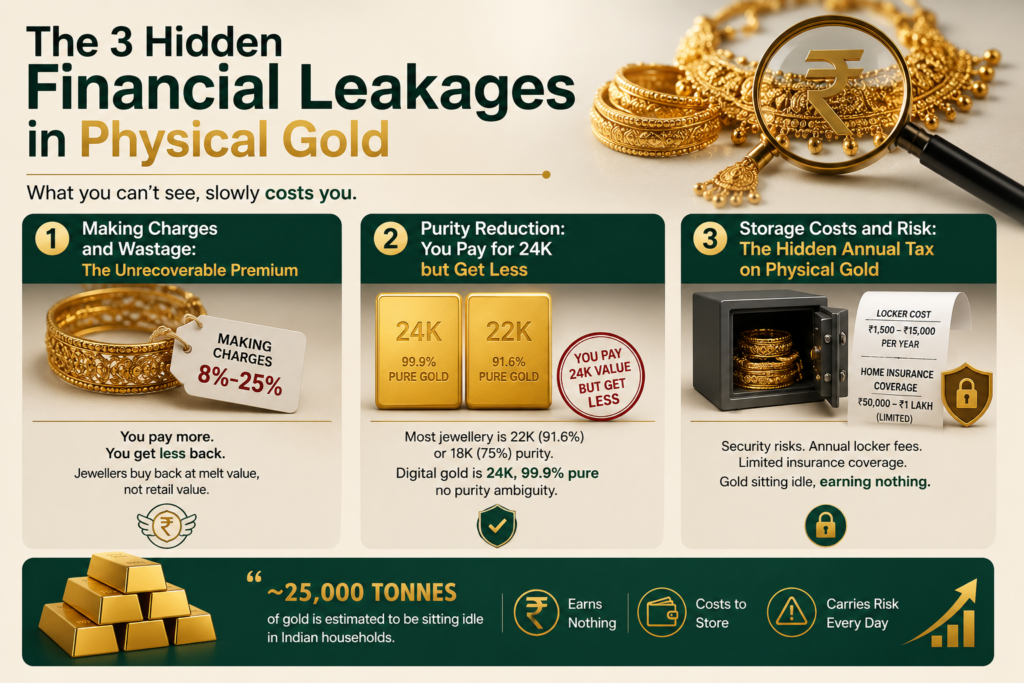
The 3 Hidden Financial Leakages in Physical Gold
1. Making Charges and Wastage: The Unrecoverable Premium
Making charges on gold jewellery range from 8% to 25% of the raw gold value, according to the World Gold Council’s India market reports. For handcrafted or branded pieces, this can go even higher. None of this is recovered on resale jewellers buy back at melt value, not retail value.
2. Purity Reduction: You Pay for 24K but Get Less
Most traditional gold jewellery is crafted in 22K (91.6% purity) or 18K (75% purity) to maintain structural durability for wearable designs. Yet buyers often pay prices close to 24K value and receive significantly less actual gold content. Digital gold is 24K, 99.9% pure by standard there is no purity ambiguity.
3. Storage Costs and Risk: The Hidden Annual Tax on Physical Gold
Storing physical gold at home carries security risks that standard home insurance rarely covers comprehensively most policies cap jewellery coverage at ₹50,000 to ₹1 lakh. A bank locker costs ₹1,500 to ₹15,000 per year depending on city and locker size, with waitlists in metro areas that can stretch to years.
And this is before accounting for the approximately 25,000 tonnes of gold estimated to be sitting idle in Indian household vaults gold that earns nothing, costs something to store, and carries risk every day it stays home.
The Structural Shift: Why This Is Permanent, Not a Trend
The data from WGC Q1 2026 is particularly striking because it held even during a quarter when gold prices were at all-time highs a period when you might expect buyers to stay away entirely. Instead:
- Investment demand rose 54% year-on-year to 82 tonnes, bars, coins, ETFs, and digital gold.
- Jewellery demand fell 19% by volume to 66.1 tonnes, but jewellery spending rose 47% in value terms, meaning buyers bought less gold jewellery but paid more for it.
- Digital gold UPI transactions nearly quadrupled year-on-year in January and February 2026, with gross UPI purchases of ₹70 billion, equivalent to 3.3 tonnes of gold in those two months alone.
- Gold ETF inflows hit a record, with 20 tonnes of net inflows in Q1, the strongest quarter on record for ETFs.
This is not a temporary price-driven substitution. It is a generational re-education about what gold ownership should look like. Younger, digitally fluent investors in India are separating the emotion of gold from the inefficiency of jewellery as an investment vehicle.
The Government Signal: 15% Import Duty Makes Jewellery Even Costlier
Effective May 13, 2026, the Government of India raised the import duty on gold and silver from 6% to 15% the steepest single increase on record through Customs Notification Nos. 15/2026, 16/2026, 17/2026, and 18/2026-Customs.
The government’s stated rationale was to address the widening current account deficit India’s gold and silver imports reached a record $84 billion in FY2025–26, accounting for 10.8% of total merchandise imports, per the Department of Economic Affairs Monthly Economic Review, May 2026.
For buyers of physical jewellery, this means that duty is now embedded in every gram of jewellery they purchase. Digital gold platforms that source from NABL-accredited domestic refineries like Augmont operate within a different cost structure — the specific impact of import duty varies by sourcing model, but the overall direction is clear: physical gold jewellery as an investment is getting structurally more expensive relative to digital alternatives.
| What This Means for Your Next Jewellery Purchase If you are buying gold for investment purposes, the 15% import duty hike (Customs Notification 16/2026, effective May 13, 2026) means the overhead on physical jewellery just increased significantly. The smartest response is exactly what WGC data shows Indians are already doing: shift accumulation to digital formats and reserve physical purchases for cultural occasions where the emotional value justifies the premium. |
The Government Signal: 15% Import Duty Makes Jewellery Even Costlier
| Feature | Physical Gold Jewellery | Digital Gold on GFolio |
|---|---|---|
| Purity | 18K–22K (75–91.6%) | 24K, 99.9% (BIS & NABL certified via Augmont) |
| Making Charges | 8–25% — Unrecoverable on resale | Zero |
| Minimum Investment | Thousands of rupees | ₹5 |
| Storage | Home risk or bank locker (₹1,500–₹15,000/year) | Insured institutional vault — No cost |
| Liquidity | Jeweller visit, purity test, negotiation | 24/7 instant sell at live market price |
| Resale Value | Melt price minus deductions | Live MCX-based market rate |
| Import Duty Impact | Full 15% duty embedded in price | Sourced via Augmont domestic refinery |
| Inheritance / Gifting | Complex split, physical handover required | Digital transfer; gift gold from ₹5 |
| SIP / Auto-Invest | Not possible | Daily, weekly, or monthly Gold SIP from ₹5 |
| Verification | BIS HUID (needs manual check) | Pre-verified 24K — No testing needed on redemption |
How Do You Pass Down Digital Gold to the Next Generation?
This is the question most Indian families ask when considering digital gold for the first time. The answer is more reassuring than many expect.
Nomination and Legal Transfer
Every digital gold account, including GFolio, supports a formal nomination process equivalent to a bank account nomination. Upon the account holder’s death, the nominee can claim the gold balance through a documented process. This creates a cleaner paper trail than splitting physical jewellery among heirs, which often leads to family disputes over valuation.
Tax Treatment on Inheritance
Inherited digital gold is not a taxable event at the time of inheritance under Indian tax law. Capital gains tax applies only when the inherited gold is sold. When calculating gains, the original owner’s purchase date and price are used as the cost basis.
Physical Redemption for Milestones
Choosing digital gold does not mean giving up physical gold for life milestones. The modern approach works in two stages: accumulate digitally through a Gold SIP avoiding making charges and storage costs during the accumulation phase and then redeem as hallmarked coins or bars when a wedding, festival, or major occasion arrives. The coins and bars from GFolio arrive pre-certified with BIS hallmark and HUID codes, with no separate purity testing required.
| GFolio Gifting Gold gifting for Dhanteras, Diwali, weddings, and corporate occasions send certified 24K digital gold from ₹5 directly from the GFolio app |
Tax on Digital Gold in India: What the Law Actually Says (2026)
The original blog post contained an error worth correcting: LTCG on digital gold is NOT triggered after 36 months. The Finance (No.2) Act, 2024 — effective July 23, 2024 — changed the holding period for LTCG on gold (physical and digital) from 36 months to 24 months.
| Tax Category | Holding Period | Tax Rate | Notes |
|---|---|---|---|
| Short-Term Capital Gain (STCG) | Under 24 months | At your income tax slab (up to 30%) | Added to total annual income |
| Long-Term Capital Gain (LTCG) | 24 months or more | 12.5% flat — No indexation | Budget 2024 amendment; effective July 23, 2024 |
| GST on Purchase | At point of purchase | 3% | Applies to every digital gold buy; standard across platforms |
| Inheritance | At time of inheritance | Zero — Not a taxable event | Tax applies only when inherited gold is eventually sold |
Tax on Digital Gold in India: What the Law Actually Says (2026)
GFolio is not a generic digital gold platform. It is purpose-built for the Indian family that wants to upgrade its relationship with gold from an emotional, high-overhead jewellery purchase to a disciplined, low-cost, certified wealth-building habit.
- ₹5 minimum: The lowest entry point of any BIS-certified digital gold SIP in India. A salaried professional, a student, or a gig worker can all build a gold accumulation habit.
- Augmont-backed: Every gram is sourced from Augmont’s BIS- and NABL-accredited refinery — one of India’s most trusted names in certified bullion.
- SEBI-regulated insured vaults: Your gold is held in vaults overseen by a SEBI-regulated framework with independent insurance — not in a bank locker you pay for separately.
- Gold and Silver SIP: Set a daily, weekly, or monthly SIP in either metal. Rupee Cost Averaging does the work across price cycles.
- Goal-based savings: Name a target a wedding, a child’s education, a family milestone and the SIP runs until you reach it.
- Gifting: Send certified digital gold to anyone in India from ₹5. No making charges. No courier risk.
- Physical redemption: When you want physical gold, redeem as BIS-hallmarked coins or bars with HUID codes. Doorstep delivery. No re-testing required.
Frequently Asked Questions
1. Is digital gold better than gold jewellery as an investment in India?
Yes, for investment purposes. Digital gold carries only 3% GST at purchase, versus 33–40% total overhead on jewellery (making charges + import duty + GST on making charges). Digital gold on GFolio is 24K pure versus 18K–22K for most jewellery. The World Gold Council Q1 2026 report confirmed that investment demand overtook jewellery demand in India for the first time since 2000, driven by investors recognising this cost difference.
2. What did PM Modi say about buying gold jewellery in 2026?
In May 2026, Prime Minister Narendra Modi urged Indian families not to buy gold jewellery for one year, citing the pressure that gold imports place on India’s current account deficit and the rupee. Days later, the government raised gold import duty from 6% to 15% via Customs Notification No. 16/2026-Customs, effective May 13, 2026. (Source: CNBC, India Today, May 2026)
3. What is the current import duty on gold in India (2026)?
Effective May 13, 2026, the government raised the total import duty on gold and silver from 6% to 15%, comprising 10% Basic Customs Duty plus 5% Agriculture Infrastructure and Development Cess (AIDC). This is the steepest single increase on record. (Source: Customs Notification No. 16/2026-Customs, Ministry of Finance, May 12, 2026)
4, What is the tax on digital gold in India — LTCG or STCG?
Under the Finance (No.2) Act 2024 (effective July 23, 2024), LTCG on digital gold is taxed at 12.5% flat with no indexation for holdings above 24 months. For holdings under 24 months, STCG is taxed at your income tax slab rate. A 3% GST is levied at the point of each purchase. Note: the older rule of 36 months for LTCG was changed to 24 months by Budget 2024. (Source: Income Tax Department, Finance (No.2) Act 2024)
5. How is digital gold passed down to the next generation?
Digital gold accounts support formal nomination — equivalent to a bank FD nomination. Upon the account holder’s death, the nominee can claim the balance through a documented process. Inheriting digital gold is not a taxable event. Tax applies only when the inherited gold is eventually sold. For calculation, the original owner’s purchase date and price are used as the cost basis. (Source: Income Tax Act, 1961)
6. Can I convert digital gold to physical gold on GFolio?
Yes. Gold accumulated on GFolio can be redeemed as BIS-hallmarked coins or bars through Augmont’s NABL-accredited refinery. Every redeemed piece carries a BIS hallmark and HUID code — no separate purity testing required on delivery.
7. How much does digital gold cost compared to physical jewellery?
On ₹10,000 invested: Physical jewellery costs approximately ₹13,375 in total (gold + import duty + making charges + GST on both), with the actual 22K gold value received being roughly ₹8,500. Digital gold on GFolio costs ₹10,300 (gold + 3% GST), and you receive 24K, 99.9% pure gold equivalent to ₹9,997 in value. The difference over 33% premium on jewellery vs 3% on digital gold is the core financial case for the switch. (Source: Customs Notification 16/2026 for duty; GST Council for GST rates; IBJA for making charge range)
Same Gold, Smarter Way to Own It
India’s relationship with gold is not changing — gold’s cultural and financial importance is permanent. What is changing is the form it takes. For the first time in recorded history, Indian investors put more money into investment-grade gold than into jewellery in a single quarter (WGC, Q1 2026). PM Modi’s May 2026 statement and the import duty hike to 15% are the government’s own signals that the jewellery-as-investment model has structural inefficiencies that the country can no longer ignore.
The families that build real gold wealth in the next decade will be those who separate the emotion of gold the wedding piece, the festival tradition, the family heirloom from the financial engine of gold accumulation. Accumulate digitally. Minimize costs. Convert to physical only when the occasion demands it.
Start your Gold SIP on GFolio from ₹5 — 24K certified gold, zero making charges, backed by Augmont’s BIS-accredited refinery, stored in SEBI-regulated insured vaults.
Coming just days before the government raised gold import duty from 6% to 15% the steepest hike on record PM Modi’s statement wasn’t just cultural advice. It was a signal of something economists had been tracking for quarters: India’s relationship with gold was structurally changing, and the shift away from physical jewellery toward smarter, more efficient forms of gold ownership had already begun well before May 2026.
By Q1 2026, investment demand for gold bars, coins, ETFs, and digital gold overtook jewellery demand in India for the first time since the World Gold Council began tracking the data in 2000.
This blog explains what changed, why it matters for your family’s wealth, and how digital gold on GFolio is built exactly for this moment.
The Numbers That Tell the Story
These are not projections. These are verified figures from the World Gold Council’s official India Focus report, released April 2026:
|
54%
Surge in gold investment demand YoY (WGC Q1 2026)
|
82t
Investment demand overtook jewellery for the first time since 2000
|
4x
Digital gold UPI transactions YoY (Jan–Feb 2026)
|
19%
Fall in jewellery demand by volume (Q1 2026)
|
What these numbers mean in plain language: Indian investors did not stop buying gold. They stopped buying it in jewellery form. They pivoted to pure investment formats bars, coins, ETFs, and digital gold that carry no making charges and deliver 24K purity at the live market rate.
Why Jewellery Is a Poor Investment Vehicle: The Real Rupee Numbers
For decades, buying gold jewellery felt like investing in gold. The math says otherwise. Here is a verified cost breakdown, using government-sourced duty figures and market-standard making charges:
| Cost Component | Physical Gold Jewellery (22K) | Digital Gold on GFolio (24K) |
|---|---|---|
| Base Gold Value | ₹10,000 | ₹10,000 |
| Import Duty (from May 13, 2026) | ₹1,500 (embedded at 15%) | ₹0 — Not Applicable |
| Making Charges (Avg. 15%) | ₹1,500 — Non-refundable | ₹0 |
| GST on Gold (3%) | ₹300 | ₹300 |
| GST on Making Charges (5%) | ₹75 | ₹0 |
| Total You Pay | ₹13,375 | ₹10,300 |
| Actual 24K Gold Value Received | ~₹8,500 (22K purity deduction) | ₹9,997 (24K, 99.9% Pure) |
| Effective Premium Over Gold Value | 33.75% Premium | 3% (GST Only) |
The gap is not small. On every ₹10,000 spent on jewellery, roughly ₹3,375 goes to overhead that you will never recover when you sell. On digital gold, that overhead is ₹300 just the GST. The rest goes entirely into gold that is 24K, not 22K or 18K.
| The Making Charge Trap Making charges are not just a one-time cost they are a permanent deduction from your resale value. When you sell jewellery back to a jeweller, they value it at the raw gold melt price, not what you paid. The 15–25% making charge you paid on purchase is simply gone. Over a lifetime of gold buying, this can amount to lakhs of rupees of lost wealth. |
The 3 Hidden Financial Leakages in Physical Gold
1. Making Charges and Wastage: The Unrecoverable Premium
Making charges on gold jewellery range from 8% to 25% of the raw gold value, according to the World Gold Council’s India market reports. For handcrafted or branded pieces, this can go even higher. None of this is recovered on resale jewellers buy back at melt value, not retail value.
2. Purity Reduction: You Pay for 24K but Get Less
Most traditional gold jewellery is crafted in 22K (91.6% purity) or 18K (75% purity) to maintain structural durability for wearable designs. Yet buyers often pay prices close to 24K value and receive significantly less actual gold content. Digital gold is 24K, 99.9% pure by standard there is no purity ambiguity.
3. Storage Costs and Risk: The Hidden Annual Tax on Physical Gold
Storing physical gold at home carries security risks that standard home insurance rarely covers comprehensively most policies cap jewellery coverage at ₹50,000 to ₹1 lakh. A bank locker costs ₹1,500 to ₹15,000 per year depending on city and locker size, with waitlists in metro areas that can stretch to years.
And this is before accounting for the approximately 25,000 tonnes of gold estimated to be sitting idle in Indian household vaults gold that earns nothing, costs something to store, and carries risk every day it stays home.
The Structural Shift: Why This Is Permanent, Not a Trend
The data from WGC Q1 2026 is particularly striking because it held even during a quarter when gold prices were at all-time highs a period when you might expect buyers to stay away entirely. Instead:
- Investment demand rose 54% year-on-year to 82 tonnes, bars, coins, ETFs, and digital gold.
- Jewellery demand fell 19% by volume to 66.1 tonnes, but jewellery spending rose 47% in value terms, meaning buyers bought less gold jewellery but paid more for it.
- Digital gold UPI transactions nearly quadrupled year-on-year in January and February 2026, with gross UPI purchases of ₹70 billion, equivalent to 3.3 tonnes of gold in those two months alone.
- Gold ETF inflows hit a record, with 20 tonnes of net inflows in Q1, the strongest quarter on record for ETFs.
This is not a temporary price-driven substitution. It is a generational re-education about what gold ownership should look like. Younger, digitally fluent investors in India are separating the emotion of gold from the inefficiency of jewellery as an investment vehicle.
The Government Signal: 15% Import Duty Makes Jewellery Even Costlier
Effective May 13, 2026, the Government of India raised the import duty on gold and silver from 6% to 15% the steepest single increase on record through Customs Notification Nos. 15/2026, 16/2026, 17/2026, and 18/2026-Customs.
The government’s stated rationale was to address the widening current account deficit India’s gold and silver imports reached a record $84 billion in FY2025–26, accounting for 10.8% of total merchandise imports, per the Department of Economic Affairs Monthly Economic Review, May 2026.
For buyers of physical jewellery, this means that duty is now embedded in every gram of jewellery they purchase. Digital gold platforms that source from NABL-accredited domestic refineries like Augmont operate within a different cost structure — the specific impact of import duty varies by sourcing model, but the overall direction is clear: physical gold jewellery as an investment is getting structurally more expensive relative to digital alternatives.
| What This Means for Your Next Jewellery Purchase If you are buying gold for investment purposes, the 15% import duty hike (Customs Notification 16/2026, effective May 13, 2026) means the overhead on physical jewellery just increased significantly. The smartest response is exactly what WGC data shows Indians are already doing: shift accumulation to digital formats and reserve physical purchases for cultural occasions where the emotional value justifies the premium. |
The Government Signal: 15% Import Duty Makes Jewellery Even Costlier
| Feature | Physical Gold Jewellery | Digital Gold on GFolio |
|---|---|---|
| Purity | 18K–22K (75–91.6%) | 24K, 99.9% (BIS & NABL certified via Augmont) |
| Making Charges | 8–25% — Unrecoverable on resale | Zero |
| Minimum Investment | Thousands of rupees | ₹5 |
| Storage | Home risk or bank locker (₹1,500–₹15,000/year) | Insured institutional vault — No cost |
| Liquidity | Jeweller visit, purity test, negotiation | 24/7 instant sell at live market price |
| Resale Value | Melt price minus deductions | Live MCX-based market rate |
| Import Duty Impact | Full 15% duty embedded in price | Sourced via Augmont domestic refinery |
| Inheritance / Gifting | Complex split, physical handover required | Digital transfer; gift gold from ₹5 |
| SIP / Auto-Invest | Not possible | Daily, weekly, or monthly Gold SIP from ₹5 |
| Verification | BIS HUID (needs manual check) | Pre-verified 24K — No testing needed on redemption |
How Do You Pass Down Digital Gold to the Next Generation?
This is the question most Indian families ask when considering digital gold for the first time. The answer is more reassuring than many expect.
Nomination and Legal Transfer
Every digital gold account, including GFolio, supports a formal nomination process equivalent to a bank account nomination. Upon the account holder’s death, the nominee can claim the gold balance through a documented process. This creates a cleaner paper trail than splitting physical jewellery among heirs, which often leads to family disputes over valuation.
Tax Treatment on Inheritance
Inherited digital gold is not a taxable event at the time of inheritance under Indian tax law. Capital gains tax applies only when the inherited gold is sold. When calculating gains, the original owner’s purchase date and price are used as the cost basis.
Physical Redemption for Milestones
Choosing digital gold does not mean giving up physical gold for life milestones. The modern approach works in two stages: accumulate digitally through a Gold SIP avoiding making charges and storage costs during the accumulation phase and then redeem as hallmarked coins or bars when a wedding, festival, or major occasion arrives. The coins and bars from GFolio arrive pre-certified with BIS hallmark and HUID codes, with no separate purity testing required.
| GFolio Gifting Gold gifting for Dhanteras, Diwali, weddings, and corporate occasions send certified 24K digital gold from ₹5 directly from the GFolio app |
Tax on Digital Gold in India: What the Law Actually Says (2026)
The original blog post contained an error worth correcting: LTCG on digital gold is NOT triggered after 36 months. The Finance (No.2) Act, 2024 — effective July 23, 2024 — changed the holding period for LTCG on gold (physical and digital) from 36 months to 24 months.
| Tax Category | Holding Period | Tax Rate | Notes |
|---|---|---|---|
| Short-Term Capital Gain (STCG) | Under 24 months | At your income tax slab (up to 30%) | Added to total annual income |
| Long-Term Capital Gain (LTCG) | 24 months or more | 12.5% flat — No indexation | Budget 2024 amendment; effective July 23, 2024 |
| GST on Purchase | At point of purchase | 3% | Applies to every digital gold buy; standard across platforms |
| Inheritance | At time of inheritance | Zero — Not a taxable event | Tax applies only when inherited gold is eventually sold |
Tax on Digital Gold in India: What the Law Actually Says (2026)
GFolio is not a generic digital gold platform. It is purpose-built for the Indian family that wants to upgrade its relationship with gold from an emotional, high-overhead jewellery purchase to a disciplined, low-cost, certified wealth-building habit.
- ₹5 minimum: The lowest entry point of any BIS-certified digital gold SIP in India. A salaried professional, a student, or a gig worker can all build a gold accumulation habit.
- Augmont-backed: Every gram is sourced from Augmont’s BIS- and NABL-accredited refinery — one of India’s most trusted names in certified bullion.
- SEBI-regulated insured vaults: Your gold is held in vaults overseen by a SEBI-regulated framework with independent insurance — not in a bank locker you pay for separately.
- Gold and Silver SIP: Set a daily, weekly, or monthly SIP in either metal. Rupee Cost Averaging does the work across price cycles.
- Goal-based savings: Name a target a wedding, a child’s education, a family milestone and the SIP runs until you reach it.
- Gifting: Send certified digital gold to anyone in India from ₹5. No making charges. No courier risk.
- Physical redemption: When you want physical gold, redeem as BIS-hallmarked coins or bars with HUID codes. Doorstep delivery. No re-testing required.
Frequently Asked Questions
1. Is digital gold better than gold jewellery as an investment in India?
Yes, for investment purposes. Digital gold carries only 3% GST at purchase, versus 33–40% total overhead on jewellery (making charges + import duty + GST on making charges). Digital gold on GFolio is 24K pure versus 18K–22K for most jewellery. The World Gold Council Q1 2026 report confirmed that investment demand overtook jewellery demand in India for the first time since 2000, driven by investors recognising this cost difference.
2. What did PM Modi say about buying gold jewellery in 2026?
In May 2026, Prime Minister Narendra Modi urged Indian families not to buy gold jewellery for one year, citing the pressure that gold imports place on India’s current account deficit and the rupee. Days later, the government raised gold import duty from 6% to 15% via Customs Notification No. 16/2026-Customs, effective May 13, 2026. (Source: CNBC, India Today, May 2026)
3. What is the current import duty on gold in India (2026)?
Effective May 13, 2026, the government raised the total import duty on gold and silver from 6% to 15%, comprising 10% Basic Customs Duty plus 5% Agriculture Infrastructure and Development Cess (AIDC). This is the steepest single increase on record. (Source: Customs Notification No. 16/2026-Customs, Ministry of Finance, May 12, 2026)
4, What is the tax on digital gold in India — LTCG or STCG?
Under the Finance (No.2) Act 2024 (effective July 23, 2024), LTCG on digital gold is taxed at 12.5% flat with no indexation for holdings above 24 months. For holdings under 24 months, STCG is taxed at your income tax slab rate. A 3% GST is levied at the point of each purchase. Note: the older rule of 36 months for LTCG was changed to 24 months by Budget 2024. (Source: Income Tax Department, Finance (No.2) Act 2024)
5. How is digital gold passed down to the next generation?
Digital gold accounts support formal nomination — equivalent to a bank FD nomination. Upon the account holder’s death, the nominee can claim the balance through a documented process. Inheriting digital gold is not a taxable event. Tax applies only when the inherited gold is eventually sold. For calculation, the original owner’s purchase date and price are used as the cost basis. (Source: Income Tax Act, 1961)
6. Can I convert digital gold to physical gold on GFolio?
Yes. Gold accumulated on GFolio can be redeemed as BIS-hallmarked coins or bars through Augmont’s NABL-accredited refinery. Every redeemed piece carries a BIS hallmark and HUID code — no separate purity testing required on delivery.
7. How much does digital gold cost compared to physical jewellery?
On ₹10,000 invested: Physical jewellery costs approximately ₹13,375 in total (gold + import duty + making charges + GST on both), with the actual 22K gold value received being roughly ₹8,500. Digital gold on GFolio costs ₹10,300 (gold + 3% GST), and you receive 24K, 99.9% pure gold equivalent to ₹9,997 in value. The difference over 33% premium on jewellery vs 3% on digital gold is the core financial case for the switch. (Source: Customs Notification 16/2026 for duty; GST Council for GST rates; IBJA for making charge range)
Same Gold, Smarter Way to Own It
India’s relationship with gold is not changing — gold’s cultural and financial importance is permanent. What is changing is the form it takes. For the first time in recorded history, Indian investors put more money into investment-grade gold than into jewellery in a single quarter (WGC, Q1 2026). PM Modi’s May 2026 statement and the import duty hike to 15% are the government’s own signals that the jewellery-as-investment model has structural inefficiencies that the country can no longer ignore.
The families that build real gold wealth in the next decade will be those who separate the emotion of gold the wedding piece, the festival tradition, the family heirloom from the financial engine of gold accumulation. Accumulate digitally. Minimize costs. Convert to physical only when the occasion demands it.
Start your Gold SIP on GFolio from ₹5 — 24K certified gold, zero making charges, backed by Augmont’s BIS-accredited refinery, stored in SEBI-regulated insured vaults.