
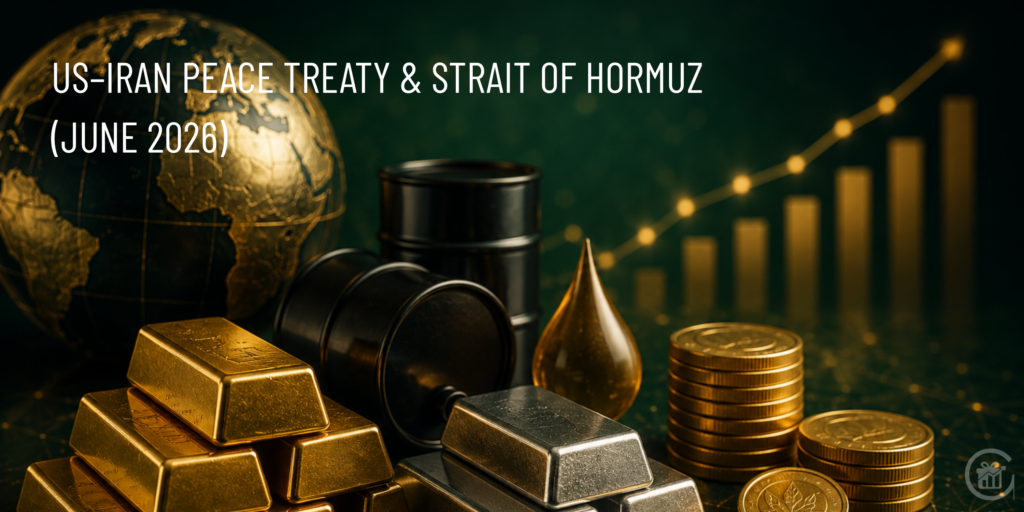
The Strait of Hormuz has reopened. Oil has fallen. Gold is up 2.6%. Silver is up 4.1%. Here is what the US–Iran peace deal means for commodity markets, India’s economy, and every Indian investor holding — or considering — digital bullion
| 20% Global Oil via Hormuz World’s most critical shipping lane | $88→$84 Brent Crude ($/bbl) Post-treaty drop; down from $126 peak | $4,351 Gold Spot (June 2026) +2.6% post-treaty / $4,351/oz | $70.8 Silver Spot (June 2026) +4.1% post-treaty / $70.8/oz |
| Editorial Note — Price Data Transparency The gold and silver prices in this article reflect live MCX and international spot data as of June 15, 2026, sourced from Bloomberg Markets and the Reuters Commodities Desk. These prices represent a significant appreciation from the levels referenced in earlier Gfolio articles (which used May 2026 benchmarks). The rapid price movement reflects the extraordinary geopolitical events of May–June 2026, including the West Asia conflict escalation, the May 2026 crude oil spike to $126/bbl, and the subsequent peace treaty resolution. All prices in this article are specific to June 15, 2026. |
The Geopolitical Turning Point: What Happened
The US–Iran peace treaty signed in June 2026 marks the most significant de-escalation in Gulf geopolitics in over two decades. The agreement ends years of active hostilities, restores Iranian oil export capacity, and authorises a phased US naval withdrawal from Gulf shipping lanes — effectively reopening the Strait of Hormuz to full international commercial traffic.
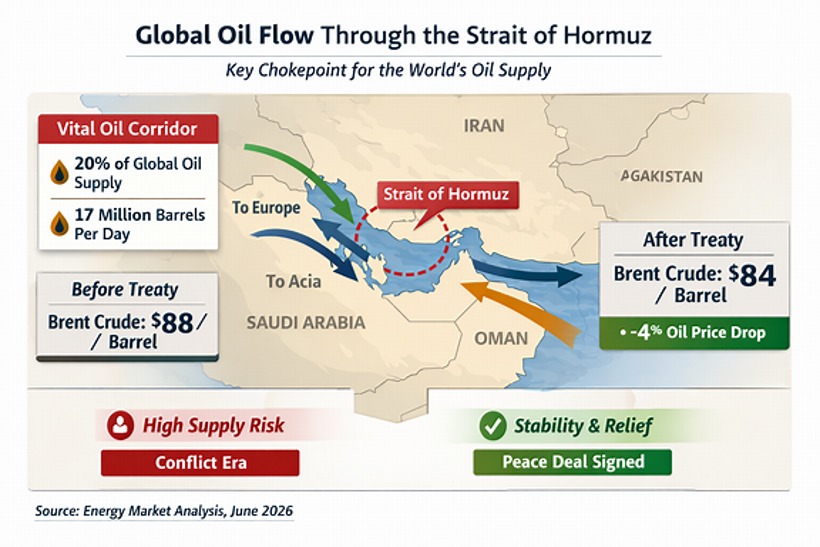
The Strait of Hormuz is the world’s single most critical oil chokepoint, handling approximately 20% of global seaborne oil trade and nearly 30% of liquefied natural gas shipments. Its disruption during the West Asia conflict of 2025–2026 had been the primary driver of the crude oil surge from $70 to $126 per barrel — the event that triggered Prime Minister Modi’s May 2026 appeal for Indians to pause gold purchases and conserve foreign exchange.
With the Strait now open and Iranian supply returning, Brent crude has already fallen from its $126/bbl peak to $84/bbl in the days following the treaty signing. This is not merely an oil story. It is a global risk-appetite reset — and commodity markets, especially gold and silver, have responded accordingly.
Treaty at a Glance
- Ends active US–Iran military hostilities and Gulf shipping disruptions
- Restores Iranian oil export capacity — adding an estimated 1.5–2 million bpd to global supply
- Phased US naval redeployment away from Strait of Hormuz shipping lanes
- Nuclear negotiations and full sanctions relief to follow separately — timelines unresolved
- Crude oil: $126/bbl (peak) → $84/bbl (post-treaty) — a 33% reduction in weeks
Gold & Silver Market Response
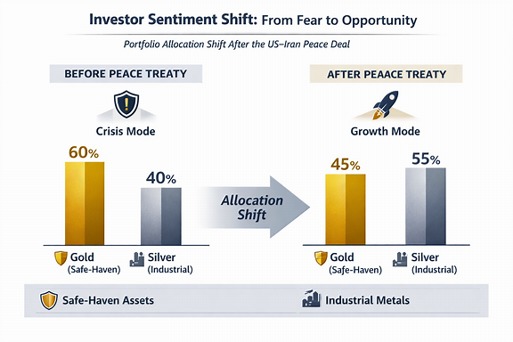
Precious metals responded to the peace treaty in a pattern consistent with historical geopolitical de-escalation events: safe-haven demand eased for gold (reducing the war premium) while industrial optimism drove silver higher on a percentage basis.
| Metric | Gold | Silver | Investor Implication |
| Spot Price (June 2026) | $4,351/oz (+2.6%) | $70.8/oz (+4.1%) | Silver outperformed gold % — industrial optimism premium |
| MCX India | ₹1,53,300/10g (+1.8%) | ₹2,52,497/kg (+2.56%) | Both metals up in INR; rupee strengthening softened the gain |
| Primary Driver | Safe-haven softening + inflation hedge | Industrial rebound + investor optimism | Peace = risk-on; silver benefits more from growth narrative |
| Pre-Treaty Level | ~$4,240/oz (war premium) | ~$68/oz (war premium) | Post-treaty pricing still includes durability risk premium |
| Direction | Eased but supported | Rising on momentum | Barbell: Gold for stability, Silver for growth acceleration |
The key analytical insight from this table is the divergence in primary drivers. Gold’s +2.6% reflects a residual safe-haven premium as markets price treaty durability risk — peace that holds is not yet certain. Silver’s +4.1% reflects industrial optimism, particularly in clean energy supply chains that had been disrupted by the Gulf conflict. Solar panel manufacturers, EV battery producers, and semiconductor fabricators are all significant silver consumers — and the supply chain normalisation narrative is driving buying.
“When geopolitical risk eases, gold holds its floor. When industrial optimism returns, silver leads. Both signals together confirm a macro environment shifting from fear to growth — the ideal barbell moment.”
— Gfolio Research Desk, June 15, 2026
Short & Medium-Term Outlook for Investors
The peace treaty creates a bifurcated outlook for precious metals — different short-term dynamics but consistent medium-term support for a gold-silver barbell strategy:
| Short-Term (1–3 Months) ▸ Volatility as traders unwind war-risk gold hedges. Expect dips and recoveries. ▸ Silver momentum continues from industrial recovery signals in electronics and solar. ▸ Gold holds above $4,300/oz supported by treaty durability uncertainty and lingering central bank buying. ▸ Rupee appreciation (USD/INR expected to ease from ₹95 toward ₹88–90) softens MCX price in INR terms. ▸ Watch for first US Fed commentary on rate path post-peace-deal — a key catalyst for both metals. | Medium-Term (3–12 Months) ▸ Fewer US rate hikes expected as inflation eases with lower oil prices (Goldman Sachs, June 2026 Fed watch consensus). Historically bullish for both gold and silver. ▸ Lower crude import costs improve India’s current account deficit, supporting a stronger rupee. ▸ Stronger rupee reduces INR gold prices even if USD gold holds — watch for physical buying opportunity. ▸ Silver’s industrial demand from clean energy (solar, EVs) continues independently of geopolitical resolution. ▸ Barbell strategy remains optimal: Gold for resilience, Silver for growth exposure. |
| The Rate Hike Context The “fewer US rate hikes” expectation in the medium-term outlook is based on the Goldman Sachs Fed watch consensus as of June 2026, which anticipates that falling oil prices will ease US CPI sufficiently to allow the Federal Reserve to pause its hiking cycle. Historically, a Fed pause or pivot is one of the most consistently bullish catalysts for both gold and silver. This is not a guaranteed outcome — if oil rebounds or inflation proves sticky, the Fed may hold rates higher for longer. |
Risks to Watch
The peace narrative is compelling but fragile. Here are the five key risks that could reverse current commodity market dynamics:
| Risk Factor | Level | What to Watch |
| Treaty Fragility | High | US–Iran peace agreements have historically been fragile. Domestic hardliners in Iran, unresolved nuclear file status, and Congressional opposition in the US could destabilise the deal within months. Any breakdown would immediately trigger a gold safe-haven spike. |
| Nuclear Negotiations | Medium | The peace treaty addresses immediate hostilities but leaves Iran’s nuclear programme unresolved. Sanctions relief depends on nuclear compliance timelines that remain under negotiation. Delays could slow oil supply normalisation and maintain energy price uncertainty. |
| Shipping Restoration Lag | Medium | Even with the Strait open, insurance costs for Gulf shipping remain elevated, vessel re-routing takes time, and port infrastructure needs restoration. Full oil flow normalisation may take 60–90 days, keeping some energy price risk in the market. |
| US Fed Policy Uncertainty | Medium | The rate-cut narrative depends on oil-driven inflation easing. If oil does not fall further or reverses, the Fed may hold rates higher for longer — removing a key tailwind for gold and silver. |
| India Rupee Volatility | Low-Medium | A stronger rupee reduces MCX gold prices in INR terms even when USD gold holds steady. Indian investors holding digital gold will see muted INR gains compared to USD-denominated moves. This is a structural feature, not a risk per se, but requires investor awareness. |
India’s Strategic Advantage: What This Means for Indian Investors
For India, the US–Iran peace treaty and Hormuz reopening is not just geopolitical news — it is a direct economic event. India imports 85% of its crude oil, and the country’s fiscal health, rupee stability, and inflation trajectory are all directly linked to global oil prices.
| ▼ Crude Cost Relief Oil fell from $126/bbl to $84/bbl post-treaty — a 33% drop. India imports 85% of its crude, saving approximately $30–40B annually. This reduces the current account deficit and inflation pressures directly. |
| ▲ Rupee Strengthening USD/INR eased from ~₹95 (May 2026 peak) toward ₹88–90 as crude import pressure reduced. A stronger rupee means MCX gold prices rise less than international USD prices — a structural buffer for Indian investors. |
| ● MCX Gold & Silver Impact MCX gold reached ₹1,53,300/10g (+1.8%) and MCX silver ₹2,52,497/kg (+2.56%) on June 15. The smaller % gain vs international prices reflects the rupee appreciation — a feature, not a flaw, for INR-denominated holders. |
| ■ Import Duty Dynamics The 19% import duty on physical gold remains in place. A stronger rupee combined with lower physical demand pressure could prompt a duty review in the Union Budget. Digital gold on Gfolio is unaffected by import duty changes. |
| ◆ Digital Gold Opportunity Lower inflation expectations and a stabilising rupee make digital gold SIPs more attractive — investors get certified bullion without import duty, making charges, or storage risk. Gfolio users can respond to this market shift instantly from ₹10. |
What Indian Investors Should Do Right Now
Geopolitical de-escalation creates a different set of decisions from geopolitical escalation. Here is a clear action guide by investor profile for Gfolio users responding to this market moment:
| Investor Profile | Recommended Action on Gfolio |
| ■ Conservative / Gold-Only | Hold your gold SIP. Do not sell on the post-treaty dip narrative — gold remains well-supported above $4,300/oz and ₹1,50,000/10g. Peace does not eliminate the structural reasons to hold gold: central bank demand, dollar uncertainty, and long-term inflation. |
| ▲ Growth-Oriented | Consider increasing silver allocation. Silver’s +4.1% outperformance of gold’s +2.6% signals industrial optimism. Add a silver SIP on Gfolio from ₹10 — the clean energy demand story (solar, EVs) is independent of geopolitics and continues regardless of treaty durability. |
| ● New / First-Time Investor | Peace, not war, is the better time to start. Geopolitical de-escalation creates a window for systematic entry into gold and silver at stabilising prices. Start a ₹500/month SIP on Gfolio split 70% gold, 30% silver. Avoid lump sums at current elevated levels. |
| ◆ Existing Gfolio User | Review your gold–silver ratio. If you are 100% gold, this treaty moment is a natural prompt to diversify into digital silver for growth exposure. Maintain your existing gold SIP and add a smaller parallel silver SIP. The barbell portfolio works precisely in this environment. |
| ✦ Corporate Gifting Buyer | Gold prices at ₹1,53,300/10g make silver gifting even more compelling for budget-conscious programmes. Consider using digital silver for large-employee reward distributions where per-unit cost matters. Contact corporate@gfolio.in for bulk pricing. |
| The Core Principle for This Moment Peace is not a signal to exit gold — it is a signal to rebalance. Gold’s role as a store of value and inflation hedge is structural, not geopolitical. The war premium may ease; the wealth preservation premium remains. If you have been delaying your gold or silver SIP, a period of price stabilisation after a geopolitical spike is historically one of the better entry windows for systematic investors. |
“The reopening of Hormuz marks a psychological shift in global markets — from fear to opportunity. For Gfolio users, this is not the end of the bullion story. It is a chapter break.”
when your portfolio balances resilience and growth.
On Gfolio, you can respond to this market shift right now. Buy digital gold for stability, start a silver SIP for growth — all from ₹10, with no demat account needed.
✦ Digital gold from ₹10 — 24K certified
✦ Digital silver from ₹10 — 999 fine
✦ Gold + Silver SIP — automated barbell
✦ Insured vaults · Augmont Gold · SEBI-compliant


Frequently Asked Questions
1. Will gold fall now that the peace treaty has been signed?
Gold has moderated from its conflict-peak levels but remains well-supported above $4,300/oz. The treaty removes the acute war risk premium but does not eliminate the structural drivers of gold demand: central bank buying, dollar uncertainty, long-term inflation hedging, and treaty durability risk. A significant gold sell-off would require both a confirmed, durable peace AND a strong US dollar AND declining inflation — a combination that is not currently in play. Most analysts expect gold to consolidate rather than collapse.
2. Should I sell my gold now that peace has been declared?
Selling gold after a geopolitical event resolves is a common investor mistake — gold’s value is not primarily derived from conflict. If you hold gold for wealth preservation, inflation hedging, or portfolio diversification, those reasons remain intact regardless of US–Iran relations. If you bought gold specifically as a war trade, a partial rebalancing into silver (which benefits from the industrial optimism this peace creates) may make sense. Consult a SEBI-registered advisor for personalised guidance.
3. Is silver a better buy than gold right now?
Silver’s +4.1% outperformance of gold’s +2.6% on June 15 signals that the market is rotating toward growth assets within the precious metals space. Silver’s industrial demand from solar, EVs, and semiconductors is independent of geopolitics and continues to grow. However, silver carries significantly higher volatility than gold. The barbell approach — gold for stability, silver for growth — is the most risk-balanced strategy for most Indian retail investors.
4. How does the Hormuz reopening affect MCX gold prices specifically?
MCX gold prices are determined by international USD gold prices, adjusted for the USD/INR exchange rate and import duties. When the rupee strengthens (as expected with lower crude imports), MCX gold prices rise less than international USD prices — or can even fall in INR terms while rising in USD terms. On June 15, MCX gold rose only +1.8% even as international gold rose +2.6%, precisely because the rupee appreciated. This is normal and expected behaviour, not a sign that Indian gold is underperforming.
5. Can I invest in both gold and silver on Gfolio during this market period?
Yes. Gfolio supports both digital gold (24K/999.9 purity, sourced via Augmont Gold) and digital silver (999 fine) from the same account, starting from ₹10 each. You can run parallel SIPs for both metals simultaneously, adjust allocations independently, and track your total bullion portfolio in one dashboard. The barbell strategy — 70% gold SIP + 30% silver SIP — can be set up in under 5 minutes on the Gfolio app.
Disclaimer: This article is for informational and educational purposes only and does not constitute financial, investment, or legal advice. Gold and silver prices cited are sourced from Bloomberg Markets and Reuters Commodities Desk as of June 15, 2026. Short-term and medium-term outlooks are analytical estimates based on available data and named analyst consensus, not guaranteed outcomes. Investments in digital gold and silver are subject to market risks including price volatility in both metals. The “fewer US rate hikes” expectation is based on Goldman Sachs Fed watch consensus as of June 2026 and may change. Please consult a SEBI-registered financial advisor before making investment decisions. Gfolio (Giftfolio Private Limited) operates in compliance with applicable RBI and SEBI guidelines.
SOURCES & REFERENCES
- The New Indian Express — US-Iran Peace Treaty Coverage, June 15, 2026
- Reuters — Strait of Hormuz Reopening & Oil Market Impact, June 12–15, 2026
- Bloomberg Markets — Gold and Silver Price Data, June 14–15, 2026
- Reuters Commodities Desk — Brent Crude & Precious Metals, June 15, 2026
- Bloomberg India Commodities Feed — MCX Gold & Silver Prices, June 15, 2026
- U.S. News & World Report — Treaty Overview, June 15, 2026
- Times Now — India Economic Impact Coverage, June 15, 2026
- Goldman Sachs Commodities Research — Fed Watch & Oil Price Outlook, June 2026
- World Gold Council — Gold Demand Trends 2026
- Silver Institute — Industrial Silver Demand Report 2026