


In a cluster of villages in Andhra Pradesh’s Kurnool district, something happened in May 2026 that hasn’t happened in India in seventy years: a private company started pulling gold out of the ground at scale.
It’s a quiet story on the surface: a mine, a processing plant, a chief minister’s inauguration speech. But the timing is anything but quiet. It lands in the middle of a forex squeeze so serious that the prime minister has personally asked citizens to ease up on gold buying. To understand why this mine matters, you have to understand both halves of that story.
The Discovery: What Actually Happened at Jonnagiri
The Jonnagiri Gold Fields, spread across nearly 598 hectares covering Jonnagiri, Erragudi, and Pagidirayi villages in the Kurnool district, began commercial operations in early May 2026 — India’s first large-scale private gold mine since Independence.
The numbers behind it:
- Developer: Geomysore Services India Pvt Ltd, backed by Thriveni Earthmovers & Infra and BSE-listed Deccan Gold Mines Ltd
- Investment: Over ₹400 crore
- Certified gold resources: 13.1 tonnes, with exploration pointing to a potential reserve of up to 42.5 tonnes
- Peak output: Up to 1,000 kg of refined gold annually, sustained for the next 15 years
- Build time: The processing plant went from construction to pre-commercial operation in just 13 months
Andhra Pradesh Chief Minister N. Chandrababu Naidu inaugurated the project, framing it as both a state achievement and a national milestone and for good reason. Beyond Jonnagiri, Geomysore is already exploring Ramagiri, Javvakula, and Chigurukunta, suggesting this may be the first of several finds in the region rather than a one-off.
What It Means for Bullion Investors and Every Indian Household
1. The First Crack in India’s Import Addiction
One mine producing up to 1,000 kg a year isn’t going to move a market that imports 800,000+ kg annually, but it’s the first real dent in a 70-year-old habit. Geomysore’s own leadership has set a far bigger ambition: pushing India toward 50–100 tonnes of domestic gold production per year within a decade. Over time, that kind of shift could moderate price volatility and improve liquidity in India’s bullion markets. That decade-out number is the one worth watching not this year’s output.
2. Your Phone Could Become Your Vault
As India’s gold ecosystem matures and supply diversifies beyond pure imports, investors are likely to lean harder into regulated, transparent digital bullion platforms. Domestic mining strengthens confidence in vault-backed gold the exact principle platforms like GFolio are built on: fractional, verifiable ownership you can start with ₹10 or ₹100, not just a full coin or jewellery piece.
3. The Government’s Next Move Could Matter More Than the Mine Itself
With the state actively trying to dampen gold-import demand, remember, this is the same government asking citizens to pause big gold purchases. Watch closely for recalibrated import duties, mining incentives, and gold-linked financial products in the coming months. Any single policy signal could move the investment calculus faster than Jonnagiri’s actual output ever will.
4. Andhra Pradesh’s Quiet Gold Rush
If the ongoing exploration at Ramagiri, Javvakula, and Chigurukunta pans out, this stops being a one-mine story and becomes a genuine regional corridor catalyzing ancillary industries like refining, logistics, and bullion trading and opening new investment avenues across Andhra Pradesh’s emerging gold belt.
5. Why This Matters Even If You’ve Never Called Yourself an “Investor”
Most Indians don’t buy gold as a “bullion strategy”, they buy it for a daughter’s wedding, for Dhanteras, for Akshaya Tritiya, or simply because it’s how their family has always saved. That’s exactly why this story matters beyond the trading desks: at a moment when the Prime Minister himself is asking households to slow down on big physical gold purchases, domestic mining and digital gold platforms together offer a quieter alternative letting families keep building their gold savings in small, regular amounts instead of one large purchase without adding more strain to the very forex reserves this mine is meant to ease.
Challenges Ahead — The Reality Check
The 1-Gram Problem: Recovery rates for this kind of deposit run around 1 gram of gold per tonne of ore, which is exactly why this style of mining demands serious capital and a lot of patience before it pays off.
Years, Not Months: Commercial output takes real time to scale. Any meaningful dent in India’s import bill is a multi-year story, not a quarterly headline.
The Mine Can’t Fight Geopolitics: Domestic mining doesn’t insulate anyone from global price swings driven by central bank buying or geopolitical shocks like the very oil crisis that’s putting pressure on India’s forex reserves and made this mine’s launch front-page news in the first place.
Investor Takeaway
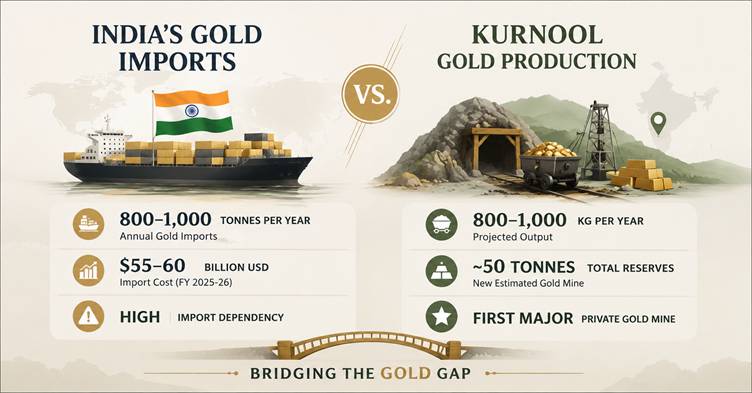
The Kurnool gold discovery is symbolically transformative — it marks India’s entry into modern private gold mining. And as of today, this is no longer a “coming soon” story: Jonnagiri officially began full commercial operations on 24 June 2026, with Andhra Pradesh CM N. Chandrababu Naidu also laying the foundation stone for a second mining unit on the same day. Jonnagiri village is even set to be renamed Swarnagiri, a small but telling sign of how seriously the state is leaning into this identity.
But the honest framing matters here: for investors, this is a long-term structural story, not a short-term price trigger. Initial output for 2026–27 is estimated at a modest 400 kg, scaling toward 1,000 kg annually and potentially 2 tonnes after future expansion against a national appetite of 800+ tonnes a year. The gap this mine closes is symbolic and strategic long before it’s material.
What’s interesting is how this story is landing against a very specific backdrop. The same government celebrating a new domestic mine is also, in the same season, asking citizens to ease up on physical gold purchases to relieve pressure on foreign exchange reserves a quiet tension between producing more gold and importing less of it. It’s not hard to see why, against that backdrop, interest in digital and vault-backed gold has been picking up rather than physical buying alone: it offers the same exposure to gold without adding to the very import pressure the country is trying to ease, it doesn’t require timing a big-ticket purchase around a wedding or festival, and it sidesteps the usual concerns around storage, purity verification, and making charges.
None of that makes physical gold obsolete, nor does it make Jonnagiri’s modest output irrelevant; both remain part of the same larger story of a country slowly rebalancing how it relates to gold. As India bridges the gap between import dependency and domestic production, the more resilient approach is likely a blend digital gold, ETFs/SGBs, and physical holdings together while keeping half an eye on policy shifts and mining progress in Andhra Pradesh over the next few years.
Sources
- Geological Survey of India (GSI) reports on Andhra Pradesh mineral reserves
- Geomysore Services India Pvt. Ltd. press releases (2025–26)
- Ministry of Mines, Government of India — Annual Report 2025
- Business Standard & Economic Times coverage on Jonnagiri gold project (May–June 2026)