


Redefining Gold in Modern India
If you’re an Indian investor, you’ve likely asked yourself: “Is now the right time to buy gold?”
The answer isn’t simple. And that’s exactly why this guide exists.
Gold is more than a shiny metal or a wedding gift. In 2026, when global currencies are weakening, debt is skyrocketing, and geopolitical tensions are rising, gold serves a purpose that many Indians still don’t fully understand: it’s financial insurance.
This comprehensive guide draws insights from industry experts, government data, and real market analysis to help you make informed gold investment decisions, whether you’re a middle-class family with limited capital or someone seeking portfolio diversification.
Why this matters now:
- Central banks worldwide have increased gold purchases by 1,000+ metric tons annually
- India holds 34,000 metric tons of gold (highest in civilian hands, according to World Gold Council)
- The rupee has depreciated significantly, eroding purchasing power
- Digital gold investments are emerging as a fintech revolution
Gold as Insurance: The Forgotten Purpose
The Core Truth Your Parents Understood
In traditional Indian households, gold wasn’t bought to make money. It was kept as ultimate insurance, a safety net for emergencies, wars, or economic collapse.
This understanding has been lost in the age of stock markets and cryptocurrency.
Here’s what changed:
Your grandmother didn’t ask, “Will gold give me 100% returns in a year?” She understood that gold was constant, a store of value that would never become worthless.
| Aspect | Gold | Currency |
|---|---|---|
| Can be printed infinitely | No | Yes |
| Subject to inflation | Minimal | High |
| The government can seize it | Difficult | Easy (through policy) |
| International acceptance | 100% | Varies |
| Historical track record | 5,000+ years | Recent (150 years) |
Why Gold is Insurance (Not a Get-Rich-Quick Scheme)
According to RBI data, India imports approximately 700-800 metric tons of gold annually. Of this:
- 60-70% is used for jewelry (cultural, wedding purposes)
- 30-40% is investment gold (bars, coins, digital)
The insight: Gold’s primary role in India is wealth preservation, not wealth creation.
When the rupee value drops, when inflation rises, and when markets crash, gold holds its ground.
The Global Gold Landscape: Central Banks & Geopolitics
Why Central Banks Are Buying Gold Aggressively
In 2022, something fundamental shifted. Central banks worldwide began purchasing gold at unprecedented rates not in small quantities, but 1,000+ metric tons annually.
Here’s why:
The Dollar Dominance Is Waning
For the past 80 years, the U.S. dollar has reigned supreme. Post-WWII, the Bretton Woods agreement established dollar supremacy, backed initially by gold.
Current status:
While the U.S. dollar remains the dominant invoicing currency, its share of global foreign exchange reserves has declined from roughly 70% in the late 1990s to about 58% today, signaling a structural trend of central banks diversifying their reserve portfolios away from heavy dollar dependency.
The Global Debt Crisis
According to IMF and international financial data:
Global GDP: ~$110 trillion
Total Global Debt (Public + Private): ~$310 to $315 trillion (Global debt-to-GDP sits near 280%–300%, meaning the world owes roughly ₹3.00 for every ₹1 earned).
As sovereign and global debt loads expand, central banks frequently resort to monetary expansion. When debt strains fiat systems, currencies face pressure, making gold a historically reliable sovereign reserve asset.
Central Banks’ Gold StrategyCentral Banks’ Gold Strategy
| Institution | Gold Reserves (Metric Tons) | Strategy |
| USA | 8,133 | Maintaining primary monetary reserve dominance |
| Germany | ~3,350 | Securing European stability and anchoring reserves |
| IMF | ~2,814 | Maintaining an institutional stability and emergency fund |
| China (PBoC) | ~2,350 (official) | De-dollarizing reserves and strengthening the Yuan’s backing |
| RBI (India) | ~850–885 | Protecting domestic currency purchasing power |
China’s Accumulation Strategy: While China does not buy 1,700 tons for its central bank alone in a single year (total global annual mine production is roughly 3,600 tons), the People’s Bank of China (PBoC) alongside robust private domestic demand has steadily accumulated official reserves past 2,350 metric tons.
Why? To structurally de-dollarize state balance sheets and reduce vulnerability to western financial sanctions.
India’s Gold Consumption: Facts & Figures
India remains one of the world’s most vital gold economies, characterized by deep cultural affinity and massive structural reserves:
- Global Market Share: India routinely ranks as one of the top two global consumers of gold jewelry alongside China, capturing roughly 25% to 30% of total worldwide jewelry demand.
- Imports: Historically imports roughly 700 to 800 metric tons of gold annually, fluctuating based on domestic price spikes and festive demand.
- Private Stockpile: Indian households hold an estimated 34,000+ metric tons in civilian hands—making it the largest private gold reserve on earth.
Breaking Down India’s Gold
By Category:
- Jewelry (household): 60-70%
- Investment (bars, coins, ETFs): 30-40%
By Class:
- Upper-middle class & High Net Worth: Actively accumulating digital gold, Sovereign Gold Bonds (SGBs), and gold ETFs.
- Middle class: A hybrid approach, purchasing lightweight hallmarked jewelry primarily for weddings or festivals, treated dual-purpose as an investment.
- Lower-middle class: Increasingly priced out of physical, heavy gold accumulation due to aggressive upward price spirals
The Accessibility Crisis
Here’s a sobering reality check using actual salary data:
In 2003:
- Gold price: ~₹5,600 per 10g
- Average middle-class monthly salary: ~₹15,000 to ₹20,000
- Relative purchasing power: A middle-class earner could buy roughly 25 to 30 grams of gold with a single month’s salary.
In Current Markets (2026):
- Gold price: ~₹1,45,000 to ₹1,52,500 per 10g (24K base rate)
- Average middle-class monthly salary: ~₹45,000 to ₹65,000
- Relative purchasing power: A monthly salary now buys roughly 3 to 4 grams of gold.
The Takeaway: While gold prices have multiplied dramatically over the past two decades, middle-class salary scales have grown at a much slower fraction. Consequently, traditional multi-gram physical accumulation is becoming a luxury reserved for higher-income brackets, shifting lower- and middle-income segments toward fractional digital formats, gold ETFs, or alternative assets.
Why Your Rupee Needs Gold Protection
Inflation quietly erodes what your money can buy. Over the last two decades, everyday costs in India—rent, education, and healthcare—have risen much faster than many salaries. Gold is one of the few assets that has historically helped protect purchasing power against this slow but steady decline.
Purchasing Power Erosion: A Real Example
In Delhi’s Mukherjee Nagar, a small rented room that cost roughly ₹300–500/month in the early 2000s can easily run ₹5,000–8,000/month today, depending on size, furnishings, and exact location. Even if your income has gone up, many households find that their real standard of living hasn’t improved in line with local prices. That gap is inflation in action and it’s why people look for hedges like gold.
Rupee vs Gold: What the Long‑Term Data Shows (2003–2026)
The table below uses widely cited Indian data to show how the rupee, gold, and equities have behaved over the long term. Figures are approximate and meant for illustration, not investment advice.
| Indicator | 2003 (approx.) | 2024 (approx.) | 2026 (Oct 2026) | 2003→2026 Change | 2003→2026 Change |
| USD/INR exchange rate | ₹46.6 per $1 | ₹83.2 per $1 | ₹88.5 per $1 | Rupee ~1.79× weaker | Rupee ~1.90× weaker |
| Gold (22K) per 10g | ₹5,650 | ₹75,000 | ₹1,52,000 | ~13.3× higher | ~26.9× higher |
| Gold CAGR (INR) | — | — | — | ~13.1% p.a. | ~15.4% p.a. |
| Sensex long-term return | — | — | — | Nominal ~12–14% p.a.; real (after inflation) ~7–9% p.a. | — |
Key takeaways
- The rupee has depreciated by roughly 2× against the dollar since 2003, not 3.5×. That means imported costs (oil, electronics, etc.) become more expensive in rupee terms over time.
- Gold in rupee terms has risen by about 13× from 2003 to 2024, and close to 27× by 2026, reflecting both global gold price moves and rupee depreciation.
- Over 20+ years, gold’s nominal CAGR in INR is around 13–15%, while the Sensex’s long‑term nominal CAGR is typically 12–14%, with real returns closer to 7–9% after inflation.
Because gold is priced globally in USD, a weaker rupee automatically pushes up the rupee gold price even if the international gold price is flat. This is why many Indian investors treat gold as a currency hedge as well as an inflation hedge.
RBI’s Gold Position (2026)
As of Q1 2026, the Reserve Bank of India holds 880.52 tonnes of physical gold. The value of these reserves has risen sharply with higher prices from around ₹6.9 lakh crore in May 2025 to over ₹11.3 lakh crore by April 2026.
Policy discussions around gold monetization schemes aim to mobilize part of India’s very large household gold stock (often estimated in the tens of lakh crores of rupees) to reduce import pressure, deepen financial markets, and give households a way to earn returns on idle gold.
Common Mistakes Indian Gold Investors Make
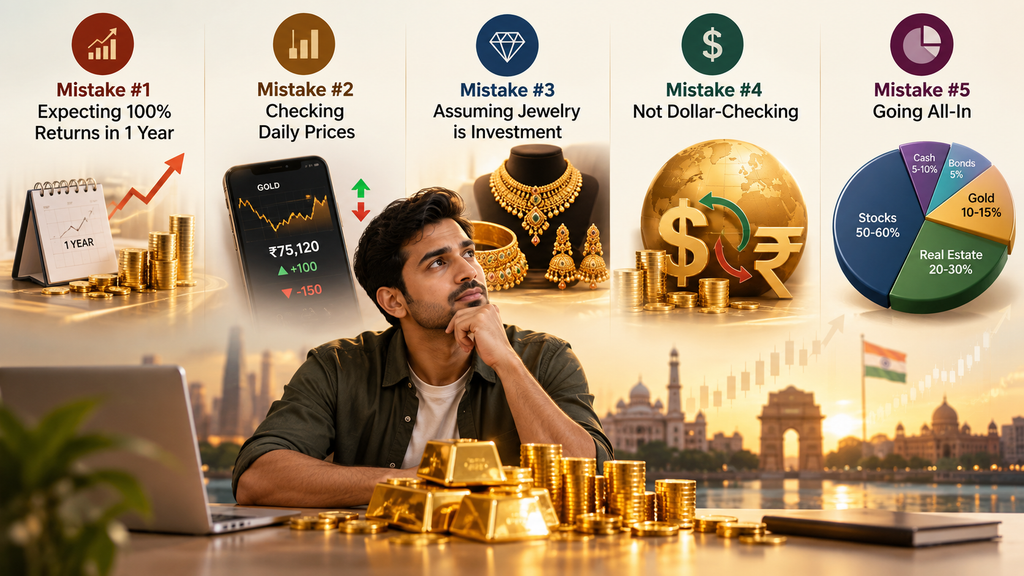
Mistake #1: Expecting 100% Returns in 1 Year
Reality: Gold CAGR = 9-10% over 20+ years
This isn’t a stock tip. It’s insurance. If you need quick money, you’re buying the wrong asset.
Mistake #2: Checking Daily Prices
The psychology trap:
- Gold up ₹100 → “Wow, my wealth increased!”
- Gold down ₹150 → “OMG, I’m losing money!”
Over 1 day: Fluctuations are normal (±2-3%)
Over 1 month: Meaningful only if you plan to sell
Over 1 year+: The noise disappears, trend emerges
Pro tip: Set a buy price and a sell price. Then don’t check daily.
Mistake #3: Assuming Jewelry is Investment
Jewelry ≠ Investment
When you buy jewelry:
- You pay 8-10% making charges
- You receive 50% resale value (jewelers give lower buyback prices)
- You lose 20-25% to taxes and bargaining
Investment gold (bars/coins) has near-100% resale value.
Mistake #4: Not Dollar-Checking
Gold prices move with the dollar, not the rupee.
When you see “Gold at ₹75,000,” it’s actually:
- Gold at $2,000/oz (global price)
- Converted to ₹75,000 (at current exchange rate)
If rupee weakens, gold prices in rupees rise (but gold in dollars stays similar).
Why this matters: Always compare gold against dollar for real returns.
Mistake #5: Going All-In
The 10% Rule: Gold should be max 10% of your total portfolio.
Portfolio allocation (conservative):
- 50-60%: Diversified stocks/mutual funds
- 20-30%: Real estate/property
- 10-15%: Gold
- 5-10%: Emergency cash reserves
- 5%: Bonds/debt
Gold’s Future: Is ₹2 Lakh Per 10g Possible?
The Math
Historical progression:
- 1980: ₹850/oz
- 2000: ₹250/oz (crashed 66%)
- 2003: ₹5,300 per 10g
- 2024: ₹75,000 per 10g
- 2050 projection: ₹2,00,000+ per 10g
Is this realistic?
Given current trends, yes—but the timeline is unknown.
Drivers: ✅ Global debt crisis forcing gold demand
✅ Weakening currencies
✅ Central bank accumulation
✅ Gold scarcity (only 900 tons mined annually vs. 3,500 tons consumed)
Constraints: ❌ New mining discoveries
❌ Nanotechnology extraction (seawater gold extraction possible by 2040)
❌ Economic stabilization
Gold Scarcity: The Real Story
Global gold reserves:
- Total gold ever mined: 256,000 metric tons
- Remaining mineable gold: ~50,000 metric tons
- Annual mining: 900 metric tons
- Annual consumption: 3,500-4,000 metric tons
The gap: Filled by recycling + central bank selling (decreasing)
At current consumption, economically mineable gold will deplete in 50-60 years.
This scarcity will drive prices higher.
Action Plan: How to Start Your Gold Investment Journey
For Beginners (Starting with ₹50,000)
- Month 1–3: Learning & Micro-Testing Phase
- Read this guide
- Download and set up a verified digital gold or micro-investing platform (such as Gfolio or licensed apps with transparent 1:1 vault backing)
- Start small: Invest a trial amount of ₹500 to ₹1,000 to understand real-time price tracking, app usability, and buy/sell spreads
- Track gold price movements for 2 weeks against fiat depreciation
- Month 4–6: Automated Accumulation Phase
- Set up a weekly or monthly digital Gold SIP of ₹2,000 to ₹5,000 to take advantage of rupee-cost averaging
- Allocate 70% into digital gold/ETFs for high liquidity and zero storage hassle, and 30% toward physical micro-coins if traditional holding is desired
- Avoid checking daily market fluctuations
- Month 7–12: Diversification & Scaling Phase
- Scale your cumulative holdings as confidence grows, targeting a balanced mix of digital accessibility and low-cost Gold ETFs
- Keep digital invoices and transaction receipts organized in a dedicated folder for easy tax tracking and capital gains record-keeping
Annual Review & Tax Optimization:
- Rebalance your asset split quarterly if market price surges skew your target weights
- Track holding periods carefully: Under current Indian tax laws, physical gold, unlisted assets/digital holdings, and Gold ETFs are subject to Long-Term Capital Gains (LTCG) tax rules (typically after a 2-year holding period, utilizing indexed or flat rates depending on the exact asset classification and budget amendments). Maintain clear documentation for all buy/sell transactions.
Frequently Asked Questions
1. Should I buy gold now or wait for a price dip?
You cannot time gold prices. No expert consistently predicts bottoms or tops.
Better approach: Dollar-cost averaging (invest fixed amount monthly regardless of price).
If you have ₹1 lakh to invest:
Option A (Lump sum): Invest ₹1 lakh today
Option B (SIP): Invest ₹10,000 for 10 months
Over 10 years, both yield similar returns. SIP reduces stress.
2. Is gold better than real estate in India?
Both complement each other.
Gold: Liquid, portable, tax-efficient (long-term capital gains)
Real estate: Generates rental income, leverages through loans, and is an inflation hedge.
Verdict: If forced to choose, invest in property first, gold second. But ideally, own both.
3. What about silver? Should I buy silver instead?
Silver is more volatile than gold.
Silver CAGR: 11% (vs. gold’s 9%)
But: Silver price swings ±15-20% (vs. gold’s ±5-10%)
Recommendation: Silver is good for aggressive investors. Beginners should start with gold.

One Response