
| Gold looks the same whether it is 91.6% pure or 86% pure. Your eyes cannot tell the difference. Three small marks, one six-character code and one free government app can. This guide shows you how to use them, in the order you would use them at the shop. |
What is inside
Five words, five seconds
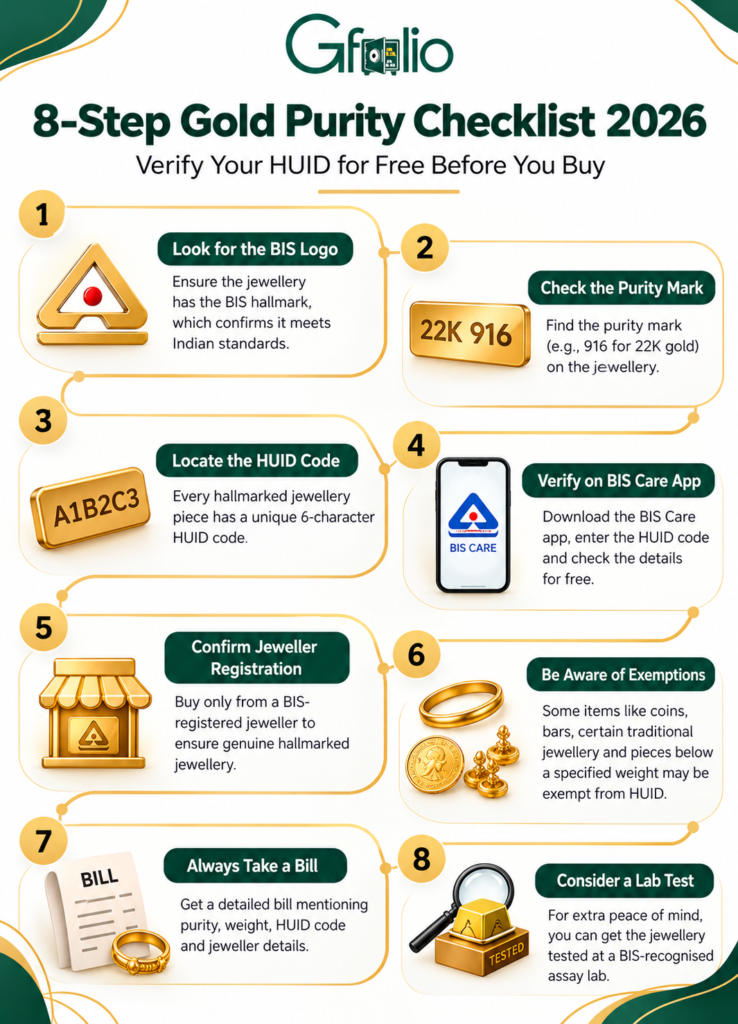
Jewellery: the 8-step check
Work through these in order. Steps 1 to 4 take about two minutes at the counter.
The BIS logo
A small BIS logo stamped on the piece. It means the gold was tested at a BIS-recognised hallmarking centre, not only checked by the shop.
A shop’s word is only a promise. This stamp means an outside lab tested a sample and recorded the result.
- Ask for a jeweller’s loupe (a small magnifier), or zoom in with your phone camera.
- Look in the quiet spots: inside a ring band, behind a pendant, near a clasp.
- The stamp should look sharp and clean, not faint or smudged.
Old-style marks without the six-character code are no longer enough. In 2026, BIS seized jewellery in Hyderabad that carried old-style hallmark markings.
The purity mark
A number that says how much of the piece is real gold. Next to the karat (22K) you will see a three-digit number (916). Both say the same thing in two ways.
| Karat | Mark | Gold content | Pure gold in 10 g |
|---|---|---|---|
| 24K | 999 | 99.9% | 9.99 g |
| 23K | 958 | 95.8% | 9.58 g |
| 22K | 916 | 91.6% | 9.16 g |
| 20K | 833 | 83.3% | 8.33 g |
| 18K | 750 | 75.0% | 7.50 g |
| 14K | 585 | 58.5% | 5.85 g |
The price you pay depends on this number. The rest of the piece is other metal that makes gold strong enough to wear. You should pay the 22K rate only for 22K.
- Read both parts. They must agree: 22K goes with 916, 18K with 750.
- Match it with the price tag and the bill.
- Ask the jeweller plainly: “What karat is this, and what is the fineness?”
The HUID code
HUID stands for Hallmark Unique Identification. It is a code of six letters and numbers, engraved on the piece. No two pieces share a code.
It links your piece to a record in a government database: who sent it for testing, which lab tested it, when, and the purity found. Since 1 April 2023, hallmarked gold jewellery must carry it.
- Count the characters. There must be exactly six.
- Check every separate item you are buying. Each needs its own code.
- Photograph the code before you leave the shop.
Having a code is not the same as having a real code. That is what Step 4 is for.
The BIS Care app check
BIS Care is the Bureau of Indian Standards’ own free app. Its “Verify HUID” feature looks up your code in the BIS records.
A stamp can be copied. In 2026, BIS busted a fake hallmarking centre in Guwahati and sealed its laser marking machine. A copied stamp can look perfect, but the app shows what BIS has actually recorded for that code.
- Download BIS Care. Check that the publisher is the Bureau of Indian Standards.
- Open it, tap Verify HUID, and type the six characters.
- Compare five details with the piece: type of article (ring, chain), purity, jeweller’s registration number, hallmarking centre and hallmarking date.
- No record, or any mismatch? Do not pay. Ask the jeweller to explain first.
- It costs nothing and works at the counter, before you pay. You do not need a bill.
BIS Care app: bis.gov.in/bis-apps
Web portal: huid.manakonline.in
The jeweller’s BIS registration
Anyone selling hallmarked gold must be registered with BIS. Registration is free and valid for life, so an honest jeweller has no reason to avoid it.
Under BIS rules, the registered jeweller who sells to you is responsible for compensating a purity shortfall. A seller with no registration leaves you with no one to hold accountable.
- Ask for the BIS registration number.
- Compare it with the number shown in the BIS Care result for your HUID.
- Search the shop on the BIS list of licensed jewellers.
When no hallmark is required
Mandatory hallmarking applies only in notified districts (380 as of March 2026). Even there, some things are exempt: pieces under 2 g, Kundan, Polki and Jadau jewellery, gold watches and pens, and jewellers with yearly sales up to Rs 40 lakh.
“Exempt” does not mean “fake”. It does mean nobody outside the shop has checked the purity. Your protection shrinks to the shop’s word.
- Prefer a BIS-registered jeweller even where hallmarking is not mandatory. A registered jeweller can sell hallmarked pieces anywhere.
- For Kundan, Polki or Jadau, ask for the net gold weight (without stones) in writing.
- Ask whether the piece can be hallmarked before you buy.
The bill
Your proof of purchase. BIS says the bill for hallmarked jewellery must show each article’s description, the net weight of the precious metal, the purity in carat and fineness, and the hallmarking charge.
Without it you cannot prove what you were sold, and you cannot claim if the purity is found short.
- Each item is listed separately, with net gold weight (stones excluded).
- The purity on the bill (for example 22K916) matches the stamp.
- Gold value, making charges and GST are on separate lines. Making charges commonly run from 6% to 25% of the gold value, depending on design.
- Putting the HUID on the invoice is optional under BIS rules. Write the code on your copy, or ask the shop to add it.
- Keep the bill and your photos for as long as you own the piece.
An independent test
You can take a piece to a BIS-recognised Assaying and Hallmarking Centre and have its purity tested. BIS counted 1,622 such centres by November 2024.
It is the one check that measures the gold itself. If a hallmarked piece tests below its marked purity, BIS rules give you compensation: twice the value of the shortfall, plus the testing fee.
- Find a centre near you on the BIS list.
- Carry the piece and the original bill.
- If the report shows a shortfall, complain through the BIS Care app and share the report with the jeweller.
Hallmarking centres: huid.manakonline.in, centre list
Home tests: what they cannot tell you
Magnet: gold is not magnetic, but neither are many fakes. A magnet only rules out iron-type metals.
Bite or scratch: soft metals are not always gold, and you can damage the piece.
Weight: tungsten is almost as dense as gold, so weight alone can fool you.
Only the BIS record or a lab test settles purity.
Coins and bars: the 3-step check
Coins and bars follow different rules. The mandatory hallmark order for jewellery does not cover them. Instead, 999 and 995 purity coins and bars may be hallmarked only by BIS-licensed refineries and mints. So you check the maker, not just the stamp.
Who made it
A coin or bar is only as trustworthy as its maker. BIS licenses refineries and mints to hallmark 999 and 995 purity gold.
Anyone can stamp “999” on metal. A BIS licence means BIS has approved the maker’s process.
- Read the maker’s name on the coin and on the pack.
- Search that name on the BIS list of licensed refineries.
- No maker name, or a name you cannot find on the list? Walk away.
Licensed refineries: bis.gov.in, refinery list (2024 edition)
The sealed pack and certificate
Coins from certified makers usually come sealed in an assay card with a certificate and a serial number.
The seal is your proof that nobody swapped the coin. A coin taken out of its card is typically tested again and priced at the buyer’s discretion.
- Never accept an opened or loose pack.
- Match the serial number on the card with the certificate.
- Check that weight and purity (999) are printed.
- Keep the card and the bill. Your resale price depends on them.
Where you buy, and how you will sell
Jewellers, banks, post offices and online sellers all sell coins. Each has a different way out.
RBI rules stop banks from buying back gold coins. A coin bought from a bank has to be sold to a jeweller or dealer, sometimes at a discount.
- Ask for the buyback policy in writing, before you pay.
- Ask for the gold value, premium and GST as separate lines. GST on gold is 3% of the gold value.
- Get a buyback quote from a second shop to compare.
Buying digital gold, or getting a coin delivered?
SEBI said on 8 November 2025 that digital gold sold on online platforms sits outside its regulation, and that the investor-protection mechanisms of the securities market do not apply to it. The SEBI-regulated ways to hold gold are gold ETFs, electronic gold receipts and exchange-traded commodity derivatives.
If a platform delivers a physical coin, apply the three Part 2 checks the day it arrives: sealed pack, certificate, known maker.
Protect yourself
These are real 2026 cases from BIS enforcement. They show what can go wrong, even in shops that look respectable.
- Hyderabad, June: about 1.6 kg seized. Some pieces had no hallmark. Others carried old-style marks.
- Guwahati, June: a fake hallmarking centre was busted and its laser marking machine sealed.
- Kadapa, August: 72.7 g seized at a hallmarking centre. The pieces had no HUID and carried spurious BIS markings.
- Chennai, September: 803.99 g of unhallmarked gold seized, including 175 mangalsutras.
- Amritsar, October: 95 ornaments (467.44 g) seized from a registered jewellery shop.
What this teaches: a stamp can be fake, old marks are not enough, and even registered shops can slip. Check the record on the app, not just the mark on the metal.
Walk away if…
- There is no bill, or you are offered a discount for paying without one.
- The price comes as one bundled number, with no gold value, making charge or GST shown.
- There is a BIS logo but no HUID, or the HUID is not found on the app.
- The jeweller will not let you check the code on the app before you pay.
- Details in the app (article, purity, jeweller) do not match your piece.
- You are being rushed: “this price is only for today”.
If something looks wrong
Pause. Do not pay, or do not accept delivery.
Ask in writing. Request the jeweller’s explanation on the bill or by message.
Test it. Take the piece and the bill to a BIS-recognised hallmarking centre.
Complain. Use the complaint feature in the BIS Care app, which allows photo uploads, or contact your nearest BIS office.
Seven things most buyers never hear
Check the price board in ten seconds
Pure gold sets the base. A 22K piece is 22/24 gold, so its rate should be about 91.7% of the 24K rate. 18K should be about 75%. If a shop’s 22K rate is well above that, you are paying extra before the making charge even starts.
| Grade | Rule of thumb | Example, 5 Oct 2026 (Rs per gram) |
|---|---|---|
| 24K | Base rate | Rs 14,918 |
| 22K | 24K rate x 0.917 | Rs 13,675 |
| 18K | 24K rate x 0.75 | Rs 11,189 |
The law pays you double
If a hallmarked piece tests below its marked purity, BIS rules give you twice the value of the shortfall, plus the testing fee. Example: a 50 g necklace marked 22K916 that actually tests at 906 is missing 0.5 g of pure gold. That is about Rs 7,500 at the early-October price. The claim would be about Rs 15,000, plus the fee. Without the bill, you have no claim.
The stamp can be faked. The record is much harder to fake
A fake hallmarking centre turned up in Guwahati, and spurious BIS markings in Kadapa, this year. A copied stamp can look perfect. The BIS Care result shows who tested the piece, when, and at what purity, so a mismatch gives it away.
Your bill does not have to carry the HUID
BIS’s own FAQ says mentioning the HUID on the invoice is voluntary, and that jewellers are not required to keep HUID records. So you do the job: write the six characters on your copy and photograph the piece with the code visible.
Where you sell matters as much as where you buy
Say you buy Rs 1,00,000 of gold at a 12% making charge plus 3% GST. You pay Rs 1,15,360. If the shop buying it back deducts nothing, gold must rise about 15.4% for you to break even. If they deduct 20%, it must rise about 44%.
| If the buyer deducts | Gold price must rise by |
|---|---|
| 0% | 15.4% |
| 10% | 28.2% |
| 20% | 44.2% |
Illustration only. It assumes a 12% making charge and 3% GST on the whole bill. Ask any shop for its buyback deduction before you buy.
The shop and the lab are both on the hook
BIS rules make the jeweller who got a piece hallmarked and the hallmarking centre that stamped it jointly responsible if a sample fails. BIS also collects samples from shops to test. So asking a jeweller to verify your HUID is not rude. It is the system working as designed.
India’s gold-purity database is already huge
More than 60 crore gold items have been hallmarked with a HUID since 2021. That is roughly four items for every ten Indians. Mandatory hallmarking began in 256 districts in June 2021 and reached 380 by March 2026. Hallmarking centres grew from 945 to 1,622. The records you can look up for free are real, large and growing.
This document is for general education only. It is not financial, investment, legal or tax advice, and it is not a recommendation to buy or sell gold or any product. Rules, district coverage, fees, procedures and prices change often. Prices and figures shown are from public sources on the dates mentioned, and the worked examples are simple illustrations built on stated assumptions. Always confirm current rules on bis.gov.in and consult a qualified professional before making decisions. No guarantee is made about accuracy, completeness or fitness for any purpose.
Glossary of Sources
1. Bureau of Indian Standards (BIS), Hallmarking FAQs for jewellers and consumers: exemptions, bill contents, bullion and coin rule, compensation, joint responsibility, HUID on invoices, registration. bis.gov.in/hallmarking-jewellers
2. BIS, hallmarking overview pages: lists of licensed jewellers, hallmarking centres and licensed refineries; BIS Care app. bis.gov.in
3. Prasar Bharati News Services (newsonair.gov.in), March 2026: sixth phase of mandatory hallmarking; more than 60 crore items hallmarked.
4. IIFL Finance, hallmarking timeline and BIS Care guides (July 2026): phase-wise district coverage (380 districts); what the app shows.
Q1. What does the BIS logo on gold jewellery mean?
It means the gold was tested at a BIS-recognized assaying and hallmarking center, not only checked by the shop. An outside lab tested a sample and recorded the result.
Q2. What is a HUID number, and where do I find it?
HUID stands for Hallmark Unique Identification. It is a six-character code engraved on each hallmarked piece, and no two pieces share one. Since 1 April 2023, hallmarked gold jewellery must carry it.
Q3. How do I verify a HUID for free?
Download the official BIS Care app, tap “Verify HUID”, and enter the six characters. Compare the article type, purity, jeweller’s registration number, hallmarking centre and date with your piece. The check is free and works before you pay.
Q4. What does 22K916 mean?
22K means 22 parts of 24 are gold. 916 is the fineness, meaning 916 parts in 1,000, or 91.6% pure gold. Both marks should agree.
Q5. Is gold without a hallmark always fake?
Not always, but it is unverified. Hallmarking is mandatory only in notified districts (380 as of March 2026), and some items are exempt, such as pieces under 2 g and Kundan, Polki or Jadau jewellery. Exempt does not mean fake, but nobody outside the shop has checked the purity.
Q6. What compensation can I get if my gold is less pure than marked?
Under BIS rules, if a hallmarked piece tests below its marked purity, you can claim twice the value of the shortfall, plus the testing fee. You need the original bill to make the claim.
Q7. Can I check gold purity at home?
Not reliably. Magnets, bite tests and weight checks can be fooled, because some fakes are magnetic or dense enough to mimic gold. Only the BIS record or a lab test at a BIS-recognised centre settles purity.