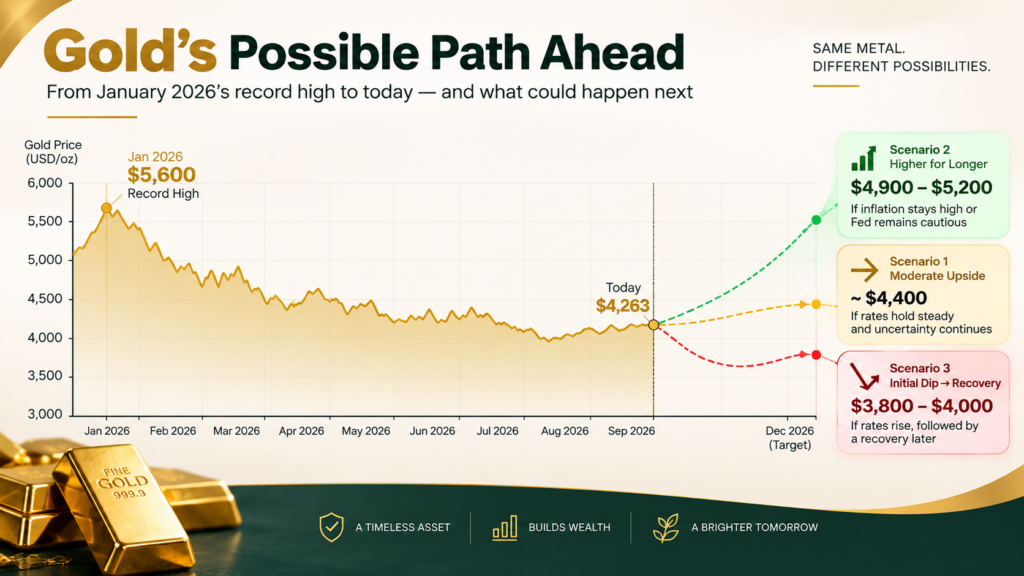
Gold is down over 20% from its January 2026 record of $5,600. What happens next depends entirely on what the Fed says tonight.
Quick snapshot (as of September 15, 2026):
| GOLD TODAY $4,263 / oz Down 1.25% on the day | OIL PRICE ~$101 / barrel Highest since May 2026 | HIKE PROBABILITY 91.4% Per CME FedWatch | US DEBT INTEREST $1 Trillion Annual cost in 2026 |
For informational purposes only. This is not financial advice. See disclaimer below.
Why Tonight Is Different
Every few weeks, twelve people sit inside a building in Washington, D.C., and vote on something that moves every financial market on the planet. Tonight, September 16, 2026, is one of those nights. Except this one carries a weight the others have not.
Gold is currently trading at around $4,263 per ounce. At the start of this year, it was at $5,600, the highest price ever recorded. That’s a drop of nearly 24% in nine months, driven almost entirely by one expectation: that the Federal Reserve was about to raise interest rates. Tonight, that expectation either becomes reality, gets defied, or gets complicated.
| THE NUMBERS GOING IN | |
|---|---|
| Gold price today | $4,263 per ounce (Sep 15, 2026) |
| Gold’s 2026 record | $5,600 per ounce (January 2026) |
| Current Fed rate | 3.50% to 3.75% |
| Market-implied hike odds | ~91% (CME FedWatch) |
| Oil price | ~$101 per barrel (Brent crude) |
| US annual debt interest | $1 trillion (2026) |
| Total US national debt | $38.4 trillion |
America is at war. The conflict with Iran that began in late February 2026 has pushed oil above $100 a barrel for the second time this year. Oil that expensive seeps into everything: fuel, food, shipping, manufacturing. Inflation stays elevated. And when inflation stays elevated, the Fed’s job is to raise rates and cool it down.
Here’s where the trap closes. The US government owes $38.4 trillion and is paying over $1 trillion a year just in interest, triple what it paid in 2020. Every rate hike makes that burden heavier. The 10-year Treasury yield briefly crossed 5% this week for the first time since 2023, driven partly by the oil-inflation scare. Fight inflation by raising rates, and you worsen the debt spiral. Go soft on inflation, and prices keep running. Either path has a cost. The Fed must choose tonight.
Gold sits at the center of this tension. It pays no interest. It has no earnings report. It is simply the oldest form of money humanity has known, and right now, it’s reacting not just to interest rates but to the broader question of whether America can solve either problem at all.
| Why this isn’t just a headline for you: Somewhere tonight, a mother in Jaipur is checking today’s gold rate before booking her daughter’s wedding jewellery order. A retiree in Pune is deciding whether to top up his gold ETF or wait a week. Neither of them will watch Kevin Warsh’s press conference live but both will feel its outcome in their bank balance by morning. That’s the real reason a Washington vote at 2:00 PM ET matters on the other side of the planet. |
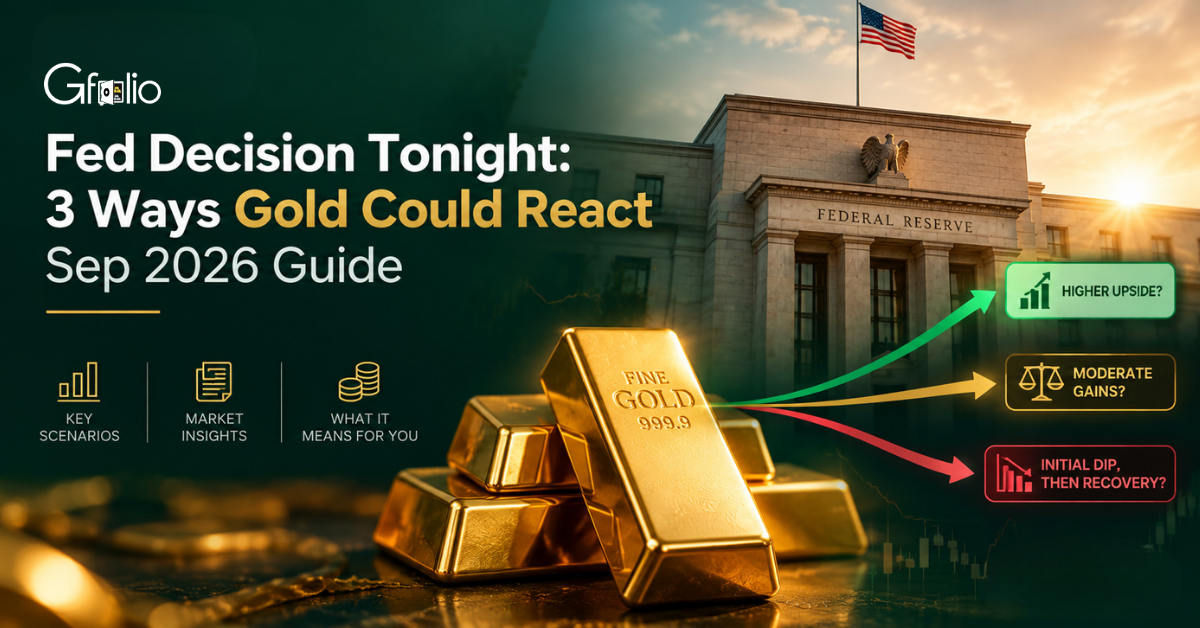
Scenario 1: The Expected Hike (≈91% probability)
The Fed raises rates by 0.25%. Markets priced a 91% chance of this. The real action won’t be in the decision itself; it’ll be in what comes after.
What happens to gold in the first hours: When the Fed raises rates, the US dollar typically strengthens bad news for gold, since gold is priced globally in dollars. A stronger dollar makes it more expensive for buyers in India, China, and Europe. Demand eases, price dips. Meanwhile, US government bonds start paying higher interest, competing directly with gold, which pays nothing at all. In the hours following a hike, gold usually falls.
But the size of that fall matters, and 2026 is unusual. Gold has already been falling for three straight weeks in anticipation of tonight, dropping over $1,300 from its January record, largely because the market was pricing in this hike. Traders call this “sell the rumour, buy the news.” When a 91% certainty becomes reality, the shock is already absorbed. The hike may land with a muted thud rather than a crash.
What Fed Chair Warsh says matters more than the rate itself. At 2:30 PM ET, thirty minutes after the rate decision, Fed Chair Kevin Warsh takes the podium. The single thing that will move gold more than the rate hike itself is this: is this the last hike, or the first of several? If Warsh signals a pause, gold could actually rally on hike day—Goldman Sachs, in its hike-with-pause scenario, forecasts gold recovering to around $4,400 by year-end.
The debt ceiling on how aggressive the Fed can be: the US government’s $38.4 trillion debt load quietly limits how many times the Fed can hike. Every 0.25% increase adds roughly $95 billion to annual debt servicing costs. With interest payments already at $1 trillion annually, further hikes risk a fiscal crisis. This makes a “one and done” signal tonight more likely than markets assume, and that’s quietly supportive for gold.
| Gold in this scenario: A modest dip of 1–2% on the day, followed by stabilization and a likely recovery toward $4,400 by year-end if the Fed signals a pause. Source: Goldman Sachs Research, 2026. |
Scenario 2: The Surprise Hold (≈9% probability)
The Fed keeps rates unchanged. Markets priced only a 9% chance of this. For gold, it would be the single most explosive outcome tonight.
When 91% of the market expects a hike and it doesn’t come, what follows isn’t a calm readjustment; it’s a scramble. Traders positioned for the hike need to reverse those positions fast. This mechanical rush to buy gold amplifies the price move well beyond what the news alone would justify.
There’s already a preview: on September 3, 2026, Fed Governor Christopher Waller merely suggested he was leaning toward a hold. Gold rose 3% in a single session, roughly ₹10,500 per 10 grams in Indian market terms. That was one official’s comment, not an actual decision. An actual hold would dwarf that reaction.
| Put a number on that feeling: if you were holding ₹5 lakh worth of gold on September 3, that single sentence from Waller added roughly ₹15,000 to your holding by the evening while you were doing nothing but going about your day. That’s the strange power gold has right now: it moves on what a Fed governor implies, not just what he decides. |
The short squeeze mechanism: when traders who bet on falling gold prices are instead met with a sharp rise, they’re forced to buy gold quickly to limit losses. That forced buying adds fuel to an already rising price; gold doesn’t just go up, it accelerates.
A hold is more bullish than it first appears. The short-squeeze rally gets the headlines, but the deeper story is what it tells the world: the Fed blinked. It decided the risk of deepening the US debt crisis outweighed the risk of letting inflation run a little longer. Gold’s only real competitor is confidence in government-issued money; when that confidence cracks, gold gains.
The India angle: a weaker dollar (likely on a hold) makes gold more accessible for buyers worldwide. The Reserve Bank of India, which added 145 metric tons to its gold reserves in 2025 alone, would likely interpret a Fed hold as a signal to accelerate purchases.
Gold in this scenario: Immediate spike of $150–$250 per ounce, followed by a more gradual bull run as inflation remains unchecked. Institutional year-end targets: $4,900–$5,200. Source: State Street Global Advisors; J.P. Morgan Global Research, 2026.
Scenario 3: The Hawkish Shock
The Fed raises rates tonight and signals more hikes are coming. The one scenario most gold holders aren’t prepared for and the one with the most complicated long-term story.
Gold’s immediate reaction would be steep. Real yields would be expected to rise further and stay higher longer, the dollar strengthens further, and a US Treasury bond yielding close to 5% becomes an increasingly compelling alternative to non-yielding gold. Goldman Sachs’ hawkish scenario places gold at $4,400 by year-end, with technical models pointing toward a potential $3,800 level if selling pressure is sustained.
The 1970s paradox nobody mentions: the last time America dealt with oil-driven, war-era inflation, the Fed raised rates aggressively and gold went up, not down, from roughly $35/oz in 1971 to $850 by 1980, even as rates climbed toward 20%. The reason: the market stopped believing the Fed could win the battle against oil-driven inflation. That dynamic isn’t off the table in 2026.
The stagflation trap: if the Fed commits to multiple hikes while oil stays above $100, the US moves toward stagflation—high inflation, slowing growth, and rising borrowing costs simultaneously. Cash loses purchasing power. Bonds lose value. Stocks struggle. Gold is historically the only major asset that has preserved real value in this environment. ANZ Bank’s economists have forecast three 25-basis-point hikes by March 2027 if inflation continues at its current pace.
The structural floor: central banks bought 1,237 tonnes of gold in 2025 roughly 20% of total annual global mine production. China, India, Poland, Kazakhstan, and Turkey are all buying consistently, for reasons unrelated to tonight’s decision largely traced back to 2022, when the US and allies froze roughly $300 billion of Russia’s central bank assets. In a 2026 World Gold Council survey, zero institutions expected global gold holdings to decrease. A drop to $3,800 would likely be treated not as a crisis, but as a discount.
| Gold in this scenario: Initial fall toward $3,800–$4,000, then a prolonged structural recovery as stagflation risk rises and central bank demand absorbs the dip. Source: Goldman Sachs; LiteFinance bear model; World Gold Council 2026 survey. |
The One Thing All Three Scenarios Share
Across all three outcomes tonight, gold isn’t simply reacting to an interest rate number. It’s reacting to what that number reveals about a larger, structural problem: the US government has too much debt, oil is being priced by a war, and central banks worldwide have quietly decided they want fewer dollars and more gold in their vaults.
The old model said higher rates hurt gold, and lower rates help it. That relationship has weakened dramatically since 2022. Sovereign buying, geopolitical hedging, and de-dollarization have given gold a demand base that doesn’t respond to a Wednesday afternoon press conference in Washington. The short-term reaction tonight will make headlines. The structural story underneath is what builds long-term positions.
At a glance
| Scenario | Short-Term Gold | Where It Goes After |
|---|---|---|
| 1 — Expected Hike (Pause) | Flat to −2% |
Recovery toward ~$4,400 (Goldman Sachs) |
| 2 — Surprise Hold | +3% to +5% |
Bull run toward $4,900–$5,200. |
| 3 — Hawkish Shock | −5% to −10% |
Stagflation recovery: central bank buying provides a floor. |
Frequently Asked Questions
1. What will happen to gold prices after the Fed’s rate decision?
It depends on the outcome. An expected hike (≈91% probability) likely means a modest 1–2% dip followed by stabilization. A surprise hold (≈9% probability) could spike gold $150–$250/oz. A hawkish hike-plus-more-hikes signal could push gold down 5–10% short-term before a structural recovery.
2. Why has gold fallen from its 2026 record high?
Gold fell from January 2026’s record of $5,600/oz to around $4,263 by mid-September 2026, a drop of nearly 24% largely because markets were pricing in an anticipated Fed rate hike.
3. What is a gold short squeeze?
It’s when traders who bet on falling gold prices are forced to buy gold quickly to limit losses after prices unexpectedly rise, which accelerates the upward price move.
4. Why are central banks buying so much gold?
In 2025 alone, central banks purchased 1,237 tonnes of gold, about 20% of global mine production, largely driven by de-dollarization concerns after the US and allies froze roughly $300 billion of Russian central bank assets in 2022.
Disclaimer
This article is produced for educational and informational purposes only. Nothing here constitutes financial, investment, or trading advice. Gold prices are subject to significant volatility, and past relationships between interest rates and gold prices may not repeat. Consult a SEBI-registered investment adviser or qualified financial professional before making investment decisions.
Sources
CME Group FedWatch Tool · Federal Reserve (federalreserve.gov) · World Gold Council · Goldman Sachs Research · J.P. Morgan Global Research · State Street Global Advisors · ANZ Bank Economics · Trading Economics · FOMC Minutes (June 17, 2026)