


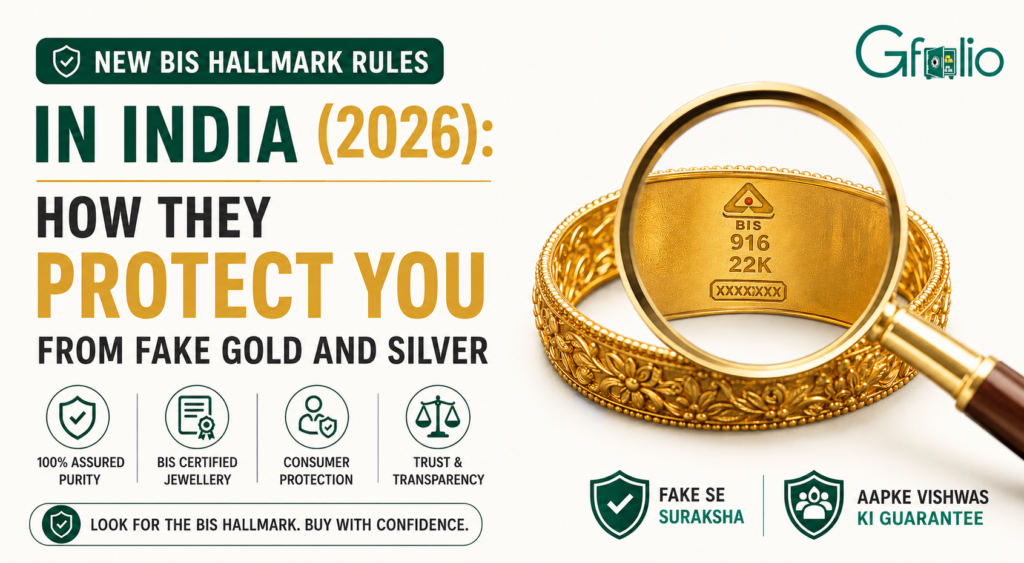
In 2026, BIS hallmarking is mandatory for gold jewellery (9K to 24K) across 380 districts in India, verified through a simplified 3-mark HUID system. Silver hallmarking is still voluntary nationwide — but any silver piece that does carry a hallmark must now include a HUID code under the revised IS 2112:2025 standard. Here’s exactly what changed, how to check your own jewellery in 30 seconds, and why digital gold investors never have to deal with any of it.
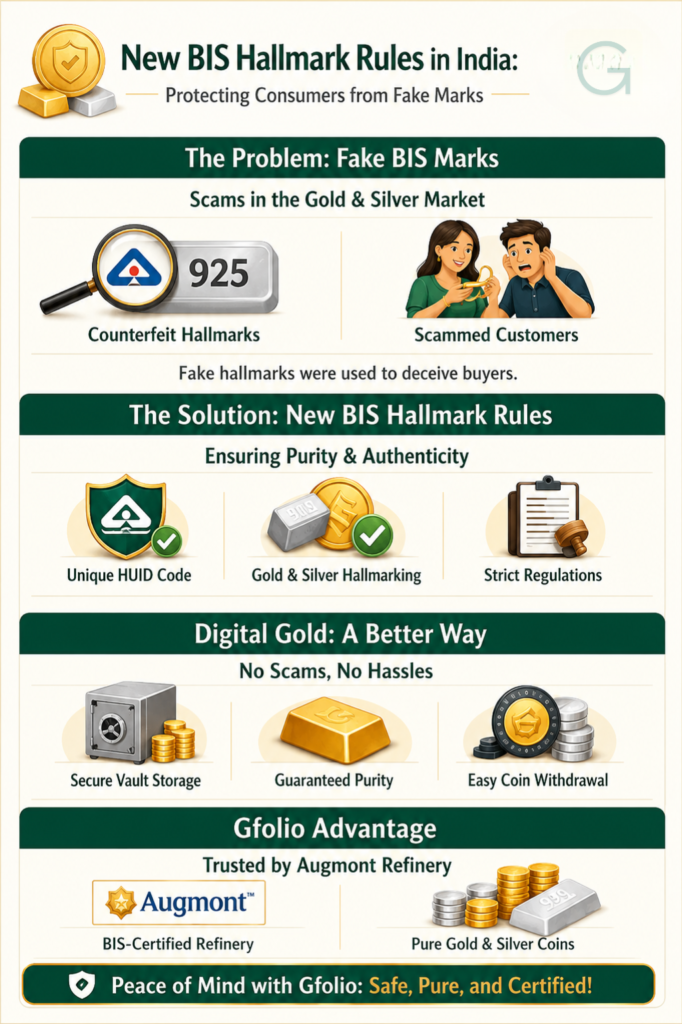
The Problem: Why a “BIS Mark” Stopped Being Enough
For years, hallmarking promised one thing: trust. Stamp the BIS triangle on a piece, and buyers assumed the purity was real. But trust is exactly what counterfeiters exploited fake BIS logos stamped onto under-karat gold and sold at full 22K prices, with no easy way for a buyer to push back.
The cost showed up in three places:
Money lost paying 22K prices for jewellery those tests closer to 18K.
Trust broken between families and the jewellers they’d used for generations.
Resale headaches every exchange meant re-testing, re-negotiating, re-doubting.
By 2026, the government’s response has moved beyond “just hallmark it” to “make every hallmark individually traceable.” That shift is the entire idea behind HUID and it’s reshaping how gold and silver get bought, sold, and verified across India.
What Is HUID, and Why Did It Replace the Old System?
HUID (Hallmark Unique Identification) is a six-digit alphanumeric code laser-engraved onto every BIS-hallmarked gold or silver item, linking that specific piece to a digital BIS record of its purity, jeweller, and testing centre.
Before 2021, a hallmark could carry up to five separate symbols the BIS logo, a purity grade, an assaying centre’s mark, and the jeweller’s own identification mark, each stamped by hand. It worked, until someone simply learned to fake the stamps.
The HUID system folded the separate assay-centre and jeweller marks into one digital trail. Every hallmarked piece today carries exactly three physical marks:
- The BIS logo: The official triangular Bureau of Indian Standards mark.
- The purity grade: e.g., “22K916”, meaning 22 karat gold at 91.6% purity.
- The 6-digit HUID: A unique code tied to one piece and one record in the BIS database.
The jeweller’s and assaying centre’s details aren’t stamped on the metal anymore they’re stored against the HUID online. That’s exactly what makes faking a 2026-style hallmark far harder than just engraving a logo: there’s nothing to copy, because the proof lives in a database, not on the jewellery.
Decoding a Real Hallmark: A 22K Gold Chain Example
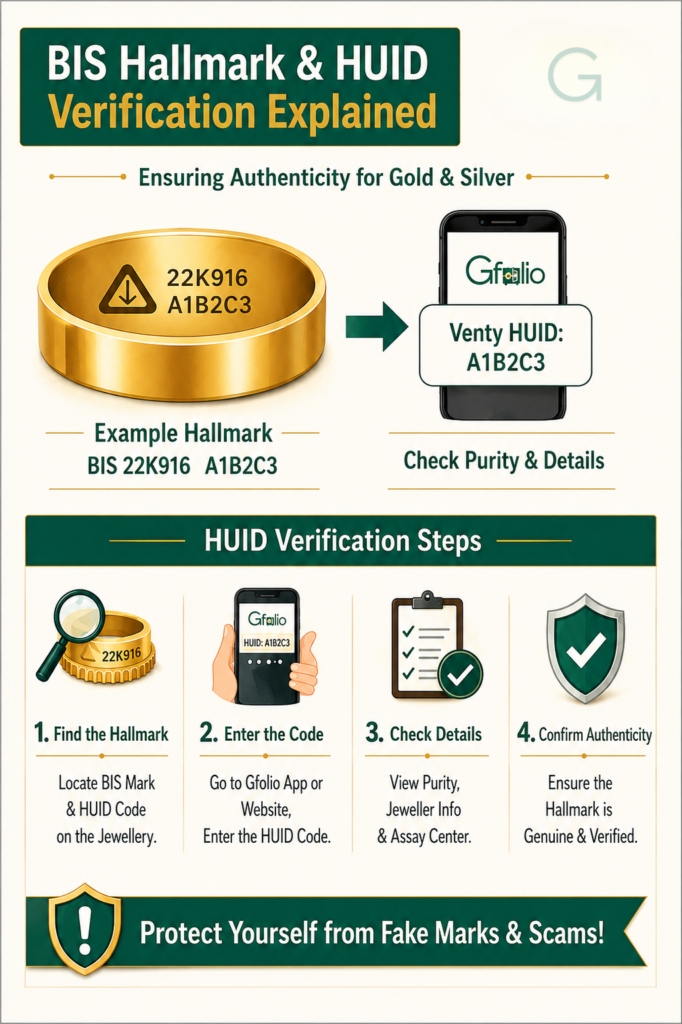
Say you buy a 22K gold chain from a BIS-registered jeweller. Look closely and you’ll find:
- BIS logo: Confirms it was tested at a recognized centre.
- Purity grade “22K916”: confirms 91.6% pure gold.
- HUID: e.g. “A1B2C3”: The unique code for that exact piece.
Enter that HUID on the BIS CARE app or the BIS website, and you instantly see the purity, the jeweller, and the assaying centre tied to that piece. If the code doesn’t exist in the database, the “hallmark” is fake no matter how convincing the stamp looks.
Gold vs Silver in 2026: Where the Rules Actually Stand
| Aspect | Gold | Silver |
| Hallmarking status | Mandatory in 380 districts | Voluntary nationwide |
| HUID requirement | Mandatory wherever hallmarking applies | Mandatory only if the piece is hallmarked at all |
| In force since | June 2021 (HUID); expanding in phases | September 2025 (IS 2112:2025) |
| Purity grades covered | 9K, 14K, 18K, 20K, 22K, 23K, 24K | 800, 835, 925, 958, 970, 990, 999 |
| Recognized testing centre’s | 900+ AHCs nationwide | 230+ AHCs nationwide |
| Penalty for violation | Fine up to 5x item value or jail up to 1 year (in mandatory zones) | No penalty yet — hallmarking itself isn’t compulsory |
Gold hallmarking has been compulsory since June 2021, and the most recent expansion the sixth phase, effective March 2026 added seven more districts, taking the total to 380. The 9-karat grade joined the mandatory list from July 1, 2025.
Silver is the one most competitor blogs misreport. As of mid-2026, the Bureau of Indian Standards has not made silver hallmarking mandatory. It remains voluntary, even as adoption climbs over 59 lakh silver articles were hallmarked in FY 2025–26, up from roughly 32 lakh the year before. What did change in September 2025 is that any silver piece a jeweller chooses to hallmark must now carry a HUID code, under the revised IS 2112:2025 standard, exactly like gold. BIS has publicly confirmed it’s building toward a mandatory framework for silver, but has deliberately avoided naming a date while it scales up testing infrastructure.
| 380 districts under mandatory gold hallmarking | 60Cr+ gold items HUID-tagged since 2021 | 3 marks on every valid hallmark today | 230+ BIS centres certifying silver |
How to Verify Any HUID in Under 30 Seconds
- Open the BIS CARE app (or visit the BIS hallmarking portal on a browser).
- Enter the six-digit HUID engraved on your piece.
- Cross-check the purity, jeweller name, and assaying centre against your invoice.
- Treat any mismatch or a HUID that returns no record at all, as a red flag and return the piece.
What Happens If a Jeweller Sells Without a Valid Hallmark
- Fine of up to 5x the item’s value, or imprisonment of up to one year, for selling unhallmarked or fake-marked gold in a mandatory-hallmarking district.
- BIS carried out more than 30 enforcement actions against violating jewellers in FY 2025–26 alone.
- Old, un-hallmarked jewellery isn’t illegal to own but reselling or exchanging it almost always means a fresh purity test before any jeweller will touch it.
The Gap Hallmarking Still Leaves Open
Even with HUID, the system protects you mainly at the counter not after. Every exchange, every resale, every “let’s just get it checked” trip back to the jeweller is still on you. A six-digit code stops fraud at the point of sale; it doesn’t remove the hassle of storing, insuring, and re-verifying physical metal for the next twenty years.
That ongoing hassle is exactly the gap digital gold was built to close.
The GFolio Advantage: Purity You Never Have to Re-Verify
At GFolio, purity isn’t something you check, it’s something that’s already been checked, before you ever see it.
- Backed by Augment’s BIS- and NABL-accredited refinery: One of India’s most respected names in gold and silver.
- Vaulted, insured, and traceable: Your holdings are tracked the way HUID tracks physical jewellery, minus the legwork.
- Pre-certified on withdrawal: Redeem your digital gold or silver as coins or bars and they arrive already carrying BIS hallmark and HUID codes, with no separate testing required.
Building a habit around this is easier than it sounds most GFolio users start with a small, recurring Gold SIP rather than a single lump-sum purchase, letting purity-checked gold accumulate automatically every week or month.
Daily-Wear Jewellery, Reinvented
GFolio isn’t just about investment-grade bullion it’s also about everyday elegance. Whether it’s a gold coin going into long-term savings, a onetime purchase or gift to someone, the purity guarantee behind it is identical.
Frequently Asked Questions
Q. Is silver hallmarking mandatory in India in 2026?
No. As of mid-2026, silver hallmarking remains voluntary across India. BIS has indicated it is preparing for an eventual mandatory rollout but has not announced a timeline. Any silver that is hallmarked, however, must carry a HUID code since September 2025.
Q. What are the three marks on a valid BIS hallmark?
The BIS logo, the purity grade (such as 22K916), and a unique six-digit HUID code. Older items may show additional marks from before 2021, but new hallmarks carry only these three.
Q. How do I check if my gold is genuinely hallmarked?
Open the BIS CARE app or the BIS website, enter the six-digit HUID engraved on the piece, and confirm that the purity, jeweller, and centre details match your invoice.
Q. Does digital gold from GFolio come hallmarked?
Yes. GFolio’s gold and silver are sourced through Augmont’s BIS- and NABL-accredited refinery, and any holdings withdrawn as physical coins or bars arrive pre-certified with BIS hallmark and HUID codes.
Q. What is the penalty for selling gold without a hallmark?
In districts where hallmarking is mandatory, selling unhallmarked or falsely marked gold can attract a fine of up to five times the item’s value, or imprisonment of up to one year.
Q. Can I verify a HUID without the BIS CARE app?
Yes the same HUID lookup is available on the BIS website, in addition to the mobile app.
The new BIS hallmarking rules are a real step toward a more transparent bullion market fewer fake stamps, clearer accountability, and a six-digit code that puts verification in the buyer’s hands. But hallmarking still asks something of you: a trip to check, a test before resale, a little vigilance every time metal changes hands.
With digital gold from GFolio, you skip that step entirely no testing, no paperwork, no second-guessing. Just verified purity, backed by Augmont’s BIS-certified refinery, from vault to hand.
Open the GFolio app and start a Gold SIP from ₹5 every gram pre-certified, no testing required.