


Every year, Indian parents gift lakhs worth of gold to their children for birthdays, Janmashtami, Rakhi, or just to start a savings habit early. Most assume the only tax question is “Will my child get taxed on this gift?” The honest, short answer is no, not at the time of the gift. But that’s not where the real tax story ends, and the part most parents never learn is the one that can actually save money later, when the gold is eventually sold.
Here we break down exactly what the law says, in plain language, verified against the Income Tax Act provisions currently in force.
Disclaimer: This article is for general educational purposes and reflects tax provisions as understood at the time of writing. Tax laws are subject to interpretation and change; please consult a qualified chartered accountant for advice specific to your situation.
Is Gifting Gold to Your Child Taxable in India?
No. Gold gifted by a parent to their child is fully exempt from income tax at the time of the gift, regardless of value, because parents and children fall within the legally defined list of “relatives” under India’s gift-tax provisions. There is no ₹50,000 ceiling, no reporting threshold, and no upper limit—you could gift gold worth ₹5 lakh or ₹50 lakh, and no income tax arises purely because of the gift itself.
This exemption currently sits under Section 56(2)(x) of the Income Tax Act, 1961, and continues under Section 92 of the Income Tax Act, 2025 (effective 1 April 2026), which carries forward the same relative-gift exemption without a monetary cap.
The ₹50,000 threshold you may have heard about only applies to gifts from non-relatives, friends, distant relatives not on the specified list, or colleagues. Parent-to-child transfers were never in that bracket to begin with.
The Real “Secret”: What Happens to the Cost and Holding Period
Here’s the part that rarely makes it into gifting articles, and it’s the actual tax-planning value in this whole topic.
When gold is gifted rather than sold, the recipient does not start a fresh cost basis. Instead, for capital gains purposes, the child inherits:
- The original purchase price the parent paid for the gold, and
- The original holding period, counted from when the parent first bought it, not from the date of the gift.
Why this matters: If a parent bought digital gold five years ago and gifts it to their child today, the child doesn’t start a fresh two-year clock to qualify for long-term capital gains (LTCG) treatment. The five years the parent already held it count. If the child sells shortly after receiving the gift, the sale can still qualify for LTCG treatment immediately, because the “clock” started when the parent bought the gold, not when the child received it.
Suppose a parent buys 50g of digital gold in 2019. In 2026, they gift it to their 16-year-old child. The child (via the parent, since the child is a minor) sells it in 2027. For tax purposes, the holding period is calculated from 2019 to 2027, well past the 24-month threshold, so the gain qualifies for LTCG at a flat 12.5% rate (without indexation, per rules applicable to sales on or after 23 July 2024), instead of being taxed at slab rates as a short-term gain.
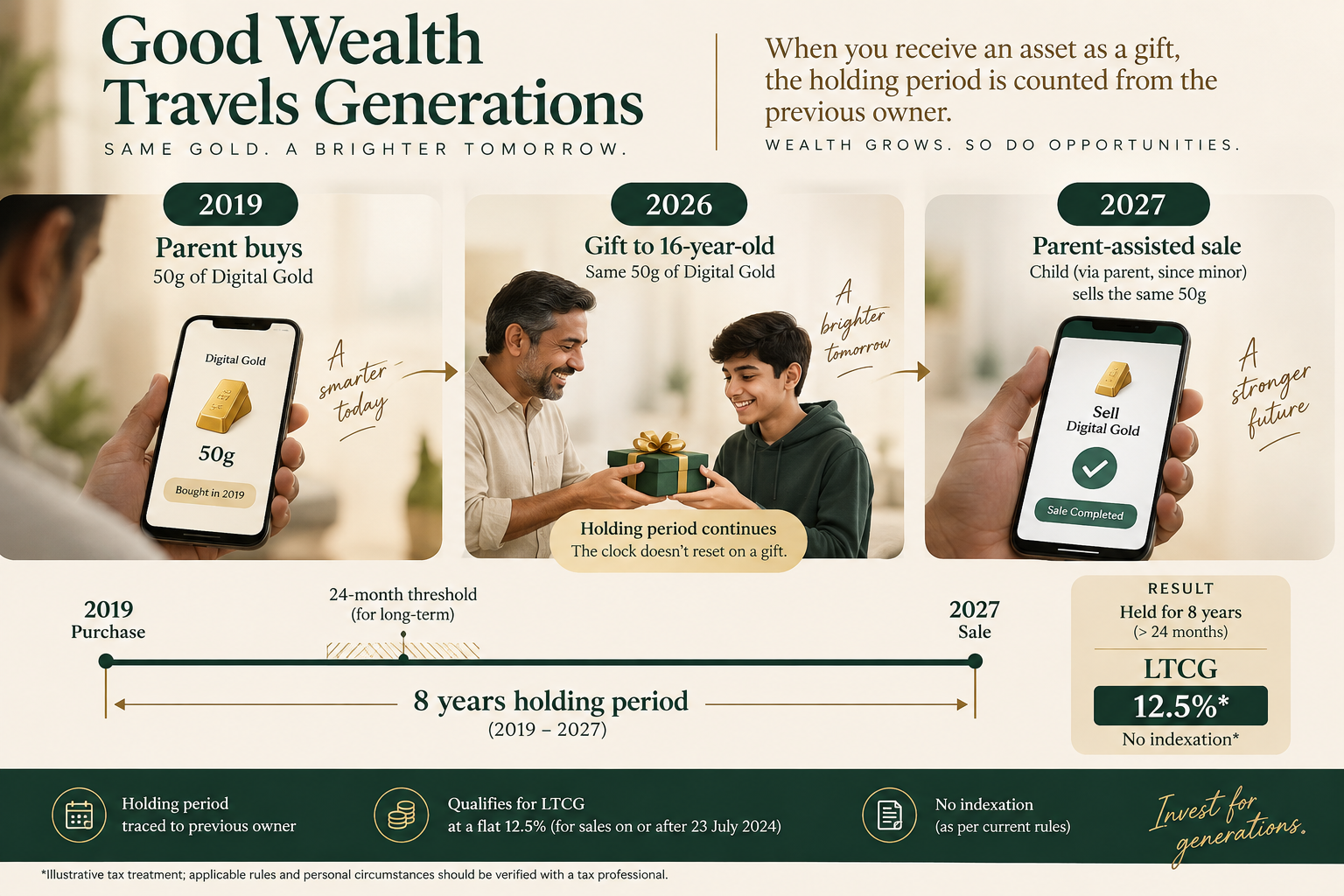
This is the mechanism that makes early gifting a genuine tax-planning move, not just a sentimental one: the earlier you gift already-held gold, the more of that holding period your child effectively “inherits.
What Happens When Your Child Later Sells the Gold
If Your Child Is Still a Minor: The Clubbing Rule
This is the part with a catch. Under Section 64(1A) of the Income Tax Act, 1961, any income, including capital gains arising from assets held by a minor child is clubbed with the income of the parent whose total income is higher (excluding the child’s income). In practice, this means:
- The gift itself: tax-free.
- But if the gold is sold while the child is still a minor, the capital gain from that sale is added to the higher-earning parent’s income and taxed at the parent’s slab rate, not the child’s.
There is one exemption that softens this: Section 10(32) allows the parent to exclude up to ₹1,500 per minor child, per year, from the clubbed income. It’s a small number, and most parents don’t even claim it, but it’s free, and there’s no reason to leave it unused if you’re already filing the clubbed income.
(Note: Sections 64(1A) and 10(32) are being renumbered under the Income Tax Act, 2025, effective 1 April 2026. The substantive rule of clubbing with the higher-earning parent, minus a small per-child exemption, is expected to carry forward. Confirm the exact new section reference with your CA closer to the effective date, since secondary sources currently differ on the precise numbering.
Exceptions to Clubbing
Clubbing does not apply if:
- The minor child has a disability recognized under Section 80U, or
- The income arises from the child’s own skill, talent, or manual work (not relevant for a gifted asset like gold).
After Your Child Turns 18: The Real Planning Window
Once your child turns 18, clubbing stops entirely. Any gold still held in their name or gold transferred to their own KYC’d account at that point is taxed in the child’s own hands, at the child’s own slab rate.
For most young adults with little or no other income, this means gains that would have been taxed at a parent’s 20% or 30% slab rate can instead be taxed at a much lower rate or fall below the taxable threshold entirely. This is the second, and arguably bigger, tax advantage of gifting gold early: you’re not just gifting an asset, you’re gifting it into a lower future tax bracket.
Digital Gold vs Physical Gold: Any Tax Difference?
For income tax purposes, digital gold is treated the same as physical gold; the same gift exemption, the same capital gains rules, and the same clubbing provisions apply. The differences are practical, not tax-related:
- GST: Both attract 3% GST at the time of purchase. Gifting doesn’t trigger a fresh GST charge; the 3% was already paid when the gold was originally bought.
- Documentation: Digital gold platforms like GFolio generate purchase and transfer records automatically, which makes it considerably easier to prove cost basis and holding period later a real advantage over physical gold, where old invoices are often lost.
- Divisibility: Digital gold lets you gift in small, specific amounts (useful for building a habit, say, every Rakhi or birthday) rather than needing to buy a full coin or bar each time.
Documentation Checklist to Protect the Tax Benefit

Common Mistakes Parents Make
- Assuming the gift itself needs to be “reported” or taxed. It doesn’t, if it’s parent-to-child.
- Forgetting the ₹1,500 minor exemption exists. Small, but it’s free money left unclaimed.
- Not tracking the original purchase date. Without it, you can’t prove the inherited holding period, and the tax office may (incorrectly, but practically) treat the sale as starting fresh from the gift date.
- Waiting until the child turns 18 to transfer anything. Gifting earlier and letting the original holding period carry forward is often more tax-efficient than waiting.
- Treating this as legal certainty rather than general guidance. Every family’s tax situation differs; a CA consultation is worth it for larger amounts.
Start Gifting Gold the Smart Way
Gifting gold to your child isn’t just a festival tradition done thoughtfully; it’s a legitimate, well-documented tax-planning tool. The exemption on the gift itself, the inherited cost basis, and the shift out of clubbing after age 18 together make early, small, and consistent gifting more efficient than a single large transfer later.
Start a Digital Gold Gift for Your Child on GFolio
Frequently Asked Questions
1. Is gold gifted by parents to children taxable in India?
No. Gold gifted by parents to their children is fully exempt from income tax at the time of the gift, with no upper limit, because parents and children are classified as “relatives” under the Income Tax Act.
2. Do I have to pay tax if I gift digital gold to my minor child?
The gift itself is tax-free. However, if the gold is later sold while your child is still a minor, the capital gains from that sale are clubbed with the income of the higher-earning parent, minus a ₹1,500 per-child exemption.
3. Does the holding period restart when gold is gifted?
No. The recipient inherits the original purchase date and cost from the person who gifted it. This means gold already held long-term by a parent can qualify for long-term capital gains treatment even shortly after being gifted.
4. What tax rate applies when gifted gold is eventually sold?
Gains from gold held over 24 months are taxed as long-term capital gains at a flat 12.5% (without indexation, for sales on or after 23 July 2024). Gains on gold held 24 months or less are taxed as short-term gains at the seller’s income slab rate.
5. Does clubbing of income apply after my child turns 18?
No. Once your child turns 18, any income or capital gains from gold held in their name is taxed in their own hands at their own slab rate, and clubbing with a parent’s income no longer applies.
6. Is digital gold taxed differently from physical gold when gifted?
No, the income tax treatment is identical. The only differences are practical GST timing, ease of documentation, and the ability to gift smaller amounts digitally.



One Response