
India’s next wave of entrepreneurs isn’t sitting in a co-working space in Bengaluru. They’re running a boutique in Indore, a packaged-foods brand out of Coimbatore, a D2C skincare label shipped from Jaipur. Tier-2 and Tier-3 cities have quietly become the country’s most active new-business frontier but the businesses growing fastest there rarely start with a bank loan. They start with something far older: gold that was already sitting in the family, now being used differently.
| Quick Answer Digital gold gives Tier-2 and Tier-3 entrepreneurs in India a way to build working capital and access credit without depending entirely on formal bank loans, which are often slow or inaccessible for new businesses without a credit history. It works as a flexible savings tool, an emergency cushion, and increasingly as collateral for gold-backed business loans combining a culturally trusted asset with modern digital access. |
Why Tier-2 India Is Becoming the New Startup Frontier
For years, “entrepreneurship in India” meant metro-city startups chasing venture capital. That’s changing. Rising internet penetration, UPI adoption, and lower operating costs are making Tier-2 and Tier-3 cities genuinely competitive places to start a business from home-based food brands to small manufacturing units and service businesses.
But growth potential and access to capital are two different things. This is where the gap and the opportunity actually lives.
The Capital Problem Most Tier-2 Entrepreneurs Face
Formal bank credit in smaller cities still comes with real friction:
- Limited or no credit history, especially for first-generation entrepreneurs and women-led businesses
- Collateral requirements that new business owners without property assets simply can’t meet
- Slow loan processing timelines that don’t match the pace a small, cash-sensitive business needs to move at
- Dependence on informal lending, often at far higher effective interest rates than formal credit
For many households in these cities, gold bought over years for weddings, festivals, and family security is already the largest liquid asset they own. The shift underway is in how that gold is being used.
How Digital Gold Fits Into the Micro-Entrepreneur’s Toolkit
A Working-Capital Cushion, Not a Locked-Away Asset
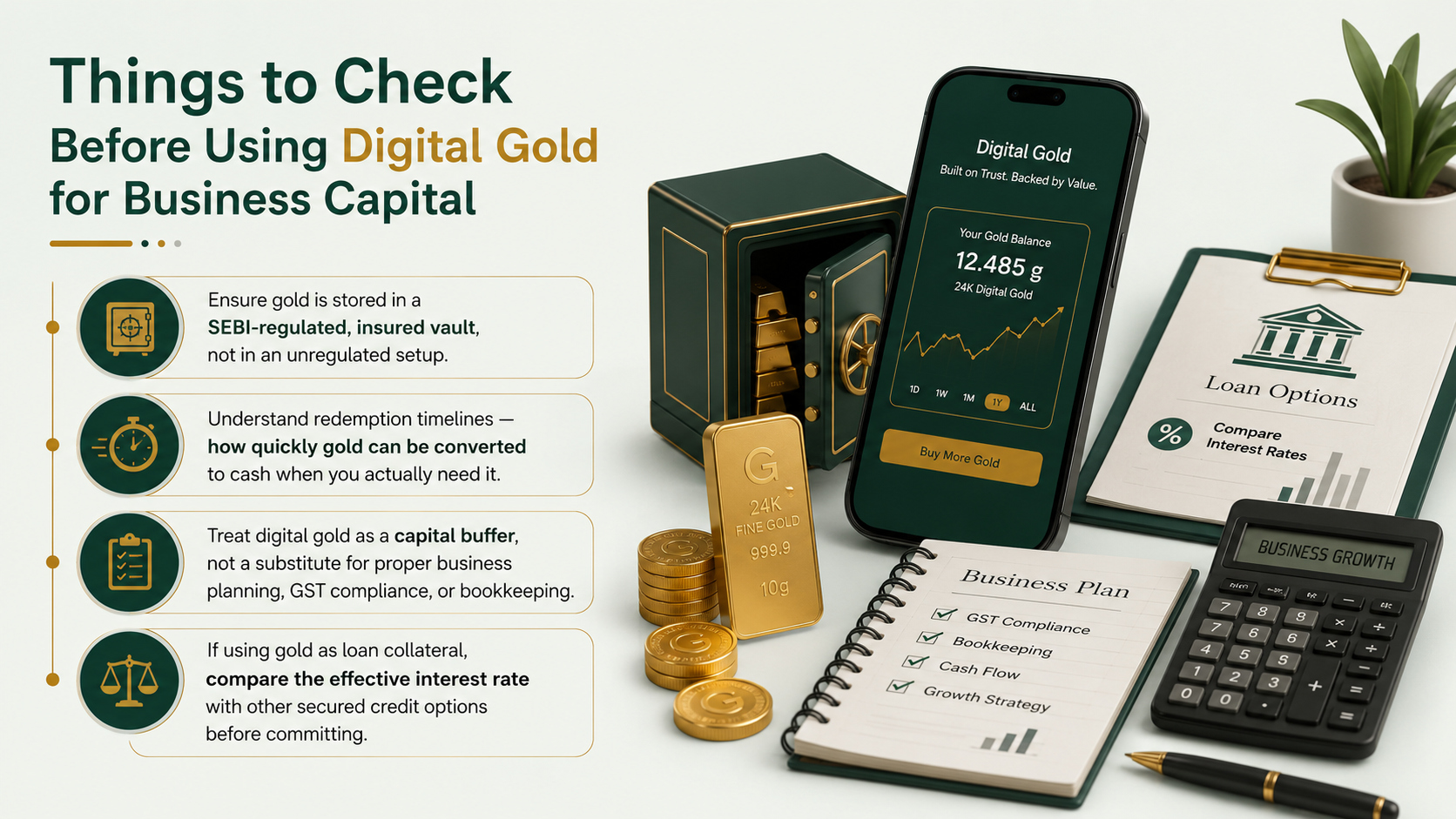
Traditionally, family gold was untouchable sold only in an emergency, and rarely for business use. Digital gold changes that calculus. Small, regular purchases build a liquid reserve that can be sold in part, instantly, without needing to physically visit a jeweller or sell an entire piece of jewellery.
Collateral for Business Credit
Gold-backed lending is one of the fastest, most accessible forms of secured credit in India precisely because it doesn’t require a credit history or income proof the way unsecured business loans do. Digital gold held in a SEBI-regulated, insured vault can increasingly be used the same way physical gold has always been used for gold loans as verifiable, liquid collateral.
A Saving Habit That Matches Irregular Business Income
Most micro-entrepreneurs don’t have predictable monthly income the way a salaried employee does. A digital gold SIP buying in small amounts whenever cash flow allows, rather than a fixed EMI-style commitment fits that irregular rhythm far better than a traditional recurring deposit.
Trust Without the Volatility Anxiety
Compared to equities or newer investment products, gold carries deep, multi-generational trust in Indian households, particularly outside metro cities. For a first-time entrepreneur already taking a major risk by starting a business, that comfort matters it’s capital management they intuitively understand.
An Illustrative Scenario
Consider a home-baking entrepreneur in a Tier-2 city who started by fulfilling small local orders. Rather than waiting to qualify for a formal business loan, she built a digital gold reserve through small, consistent purchases over several months, using it as a buffer to buy ingredients in bulk during high-demand seasons and later as collateral to access a small gold-backed loan to buy a second oven. This is the pattern showing up across many small towns: gold as flexible, self-managed working capital, not a locked emergency fund.
Digital Gold vs Gold Loan vs Unsecured Business Loan
| Dimension | Digital Gold (self-funded) | Traditional Gold Loan | Unsecured Business Loan |
| Credit history required | None | Minimal | Usually required |
| Speed of access | Instant, self-directed | Same day to a few days | Days to weeks |
| Collateral needed | Uses gold you already own | Physical gold pledged | None, but harder to qualify |
| Interest cost | None (it’s your own asset) | Relatively low, secured rate | Typically higher, unsecured rate |
| Best suited for | Building a buffer, gradual capital building | Immediate lump-sum need | Larger, planned expansion |
Digital Gold vs Gold Loan vs Unsecured Business Loan
Digital gold works best as part of a broader capital toolkit, not a replacement for institutional support. Entrepreneurs in Tier-2 and Tier-3 cities also have access to:
- Pradhan Mantri MUDRA Yojana (PMMY) — collateral-free loans for small and micro enterprises
- Prime Minister’s Employment Generation Programme (PMEGP) — subsidy-linked credit for new micro-enterprises
- Startup India — registration benefits, tax exemptions, and funding access for eligible new businesses
- Ministry of MSME — schemes, registration (Udyam), and sector-specific support
Frequently Asked Questions
1. Can I use digital gold to start a small business in a Tier-2 city?
Yes. Many entrepreneurs use digital gold as a self-funded working capital buffer, built through small regular purchases, to cover early business expenses without depending on a formal loan approval process.
2. Is digital gold safer than a traditional gold loan?
They serve different purposes. Digital gold you already own carries no interest cost since it’s your own asset, while a gold loan involves pledging gold for borrowed cash at a secured interest rate. Both are considered lower-risk than unsecured borrowing.
3. Do I need a credit history to use digital gold for my business?
No. Since digital gold is an asset you already own, using it as a savings buffer or as collateral for a gold-backed loan doesn’t require the credit history that unsecured business loans typically demand.
4. How is digital gold different from keeping physical gold at home?
Digital gold is stored in a regulated, insured vault, is easier to buy or sell in small amounts, and removes the security risk of storing physical gold at home while remaining backed by real, verifiable gold.
5. What government schemes can Tier-2 entrepreneurs combine with digital gold savings?
Programs like the Pradhan Mantri MUDRA Yojana and PMEGP offer collateral-free or subsidy-linked credit that can be used alongside a digital gold buffer for a more complete capital strategy.
Key Takeaways
Tier-2 and Tier-3 India’s entrepreneurship boom isn’t waiting for formal credit systems to catch up — it’s building around them, using an asset Indian households have trusted for generations. Digital gold won’t replace institutional lending, but as a flexible, self-directed capital buffer with no credit-history barrier, it’s becoming a genuine part of how small-town businesses fund their first, hardest year.
Want to see how a digital gold buffer could work alongside your business plan? Explore Gfolio’s digital gold savings tools