


Every time you check today’s gold rate, you’re seeing the end result of a chain that starts on a trading floor in London or New York, not in a jewellery showroom in Mumbai or Chennai. Between that global bullion price and the number your jeweller quotes, gold passes through a currency conversion, three layers of government duty and tax, and a set of local costs that can shift the price by thousands of rupees per 10 grams depending on which city you’re standing in.
This guide breaks down that entire chain, step by step, with a real worked example so you can calculate it yourself plus why the same 24K gold can cost more in Chennai than in Delhi on the very same day.
Gold prices in India are calculated by taking the international bullion rate (set by the LBMA/COMEX in USD per troy ounce), converting it to INR using the current USD/INR exchange rate, then adding India’s import duty (~15%), the Agriculture Infrastructure and Development Cess (~2.5%), GST (3%), and finally local costs like transport, insurance, and jewellers’ making charges. This is why gold rates differ slightly from city to city even though the global starting price is the same.
What Determines Gold Price in India: 5 Core Factors
- International bullion rate — the base price set on global exchanges
- USD/INR exchange rate — a weaker rupee makes gold costlier, even if the dollar price hasn’t moved
- Government duties and taxes — import duty, AIDC, and GST, all fixed by policy
- Local logistics — transport and insurance from ports to your state
- Jewellers’ making charges — labour and design costs, which vary by retailer and demand
Step-by-Step: How Gold Price Is Calculated
1. Global Bullion Price (LBMA / COMEX)
Gold is priced globally in US dollars per troy ounce, benchmarked twice daily by the London Bullion Market Association (LBMA), with COMEX futures in New York also influencing intraday moves. Since India imports the vast majority of its gold, this international price is the true starting point of every rate you see quoted locally.
2. Conversion to INR
The USD price is converted to Indian Rupees using the prevailing USD/INR exchange rate. This step alone means gold prices in India can move even on a day when international gold is flat a weakening rupee pushes local prices up, and a strengthening rupee pulls them down.
3. Import Duty and Taxes
Three separate levies are added on top of the converted price:
- Basic Customs Duty (~15%), levied by the Government of India on imported gold
- Agriculture Infrastructure and Development Cess, AIDC (~2.5%), layered on after customs duty
- GST (3%), applied at the retail sale stage on the value of gold; a separate 5% GST typically applies to making charges when jewellery is purchased
Duty rates are revised periodically in the Union Budget and customs notifications always check the CBIC customs notifications for the current applicable rate before relying on any fixed percentage.
4. Local Additions
- Transport and insurance from ports (Mumbai, Chennai) to inland states
- Jewellers’ making charges, which vary by design complexity, brand, and local demand
- Local handling costs, though GST has largely standardized taxation across states
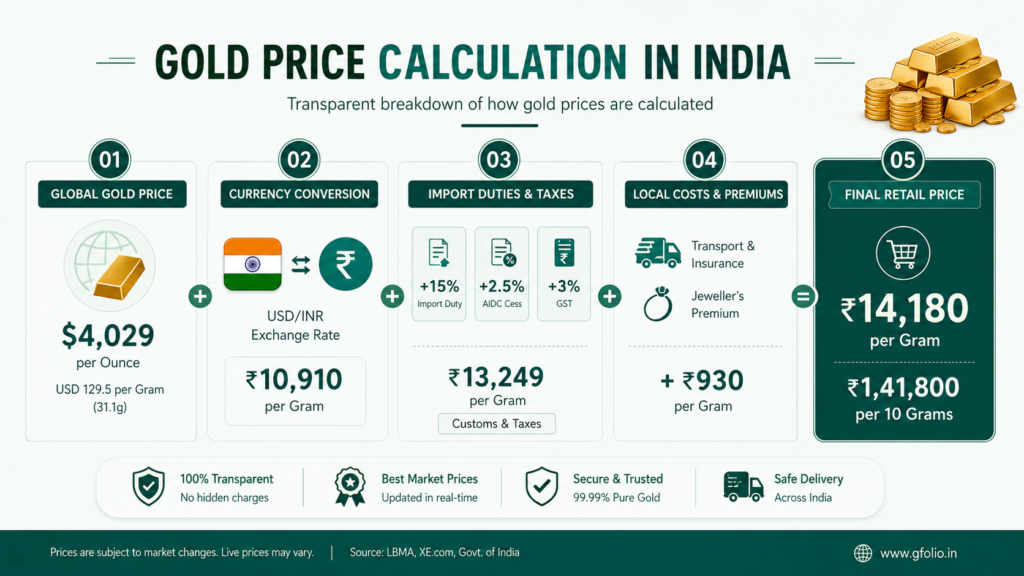
Today’s Gold Price in India (Illustrative)
Rates below are illustrative for 29 July 2026 and change daily. Always confirm live rates with your jeweller or IBJA before purchasing.
| City | 24K Gold (per 10g) | 22K Gold (per 10g) |
|---|---|---|
| Mumbai | Rs 1,42,000 | Rs 1,30,167 |
| Delhi | Rs 1,41,750 | Rs 1,29,938 |
| Chennai | Rs 1,42,410 | Rs 1,30,543 |
| Kolkata | Rs 1,41,810 | Rs 1,29,993 |
| Bengaluru | Rs 1,42,110 | Rs 1,30,268 |
| Hyderabad | Rs 1,42,220 | Rs 1,30,368 |
National average for 24K gold today: approximately Rs 14,180 per gram (Rs 1,41,800 per 10g).
Worked Example: From $4,029/oz to Rs 14,180/gram
Here’s exactly how today’s retail price is derived from the international rate, step by step.
- Global price: $4,029 per troy ounce
- Convert to grams: 1 troy ounce = 31.1035g, so price per gram = 4029 / 31.1035 = approximately $129.5
- Convert to INR: at an exchange rate of Rs 84.2/USD, 129.5 x 84.2 = approximately Rs 10,910
- Add import duty (15%): 10,910 x 1.15 = approximately Rs 12,547
- Add AIDC (2.5%): 12,547 x 1.025 = approximately Rs 12,863
- Add GST (3%): 12,863 x 1.03 = approximately Rs 13,249
- Add local premiums and transport (approximately Rs 930/g): final retail price = approximately Rs 14,180/g
(Figures are rounded for illustration; actual duty/tax rates should be verified against current government notifications.)
Why Gold Rates Differ Across Indian Cities
- Transport costs: moving bullion inland from port cities adds roughly Rs 50-100 per gram
- Local demand: high-demand states such as Tamil Nadu and Kerala often carry higher premiums
- Jewellers’ margins: competitive metro markets like Delhi and Mumbai tend to keep margins tighter
- Local levies: minor handling-charge variation persists despite GST standardization
Why Gold Rates Differ Across Indian Cities
24K gold is 99.9% pure and is the benchmark used for international bullion pricing, but it’s too soft for most jewellery. 22K gold (91.6% purity) is the standard for jewellery in India — its price is calculated as a proportion of the 24K rate (roughly 22K price = 24K price x 0.916), before making charges are added on top. This is why a 22K necklace and a 24K coin of the same weight are never priced the same, even on the identical trading day. [Read our full 22K vs 24K comparison ->]
What Causes Gold Prices to Fluctuate Daily
- Global economic uncertainty and safe-haven demand
- US Federal Reserve interest rate decisions
- USD/INR exchange rate movements
- Domestic wedding-season and festival demand (Akshaya Tritiya, Dhanteras)
- Central bank gold-buying trends, including the RBI’s own reserves
How to Track Live Gold Prices
For real-time accuracy rather than a static table, track rates through the IBJA daily rate sheet, MCX gold futures, or your bank/fintech app’s live gold price feed. [Track live gold rates and start investing digitally with Gfolio ]
Frequently Asked Questions
1. What is the main factor behind today’s gold price in India?
The international bullion rate (LBMA/COMEX), converted to INR, is the base. Import duty, AIDC, GST, and local costs are then added on top.
2. Why is gold more expensive in Chennai than in Delhi?
Higher local demand, competitive dynamics, and transport costs in Tamil Nadu typically push Chennai’s rates above Delhi’s, even though both start from the same international price.
3. Does making charge count as tax?
No. Making charges are a separate fee for craftsmanship and design set by the jeweller, and are taxed at 5% GST, distinct from the 3% GST on the value of gold itself.
4. How often do gold prices change in India?
Rates are typically revised daily, and sometimes multiple times a day, based on international bullion movements and USD/INR fluctuations.
5. Is the import duty on gold fixed?
No, it is set by the Government of India and can be revised in the Union Budget or via customs notifications, so always check the latest CBIC notification.
6. What is the difference between MCX gold price and jewellery shop price?
MCX price reflects futures trading value for standard gold contracts and excludes making charges and retail margins, so it will typically be lower than the price quoted at a jewellery counter.
Gold prices in India begin at the global import price and rise through import duty, AIDC, GST, and local costs before reaching a jeweller’s counter. Today’s 24K gold price is approximately Rs 14,180 per gram nationally, though your city, purity, and jeweller’s margins will shift the final number. Chennai often reports the highest metro rates, while Delhi tends to run lowest.
Want to start investing in gold digitally instead of tracking daily rate changes? Explore Gfolio’s Digital Gold On Play Store and app store also available.