


Indian households are sitting on an estimated 30,000–35,000 tonnes of gold most of it locked away in lockers, doing nothing. On July 15, 2026, the National Stock Exchange (NSE) took another step to change that, deepening its partnership with Augmont Enterprises Limited to strengthen India’s Electronic Gold Receipts (EGR) ecosystem.
If you’ve been hearing “EGR” everywhere and aren’t sure what it means for you or whether it’s even something you can use this guide breaks it down plainly, including the one detail most articles skip: you need a demat account and a broker with gold exchange membership to buy an EGR at all.
What Is an Electronic Gold Receipt (EGR)?
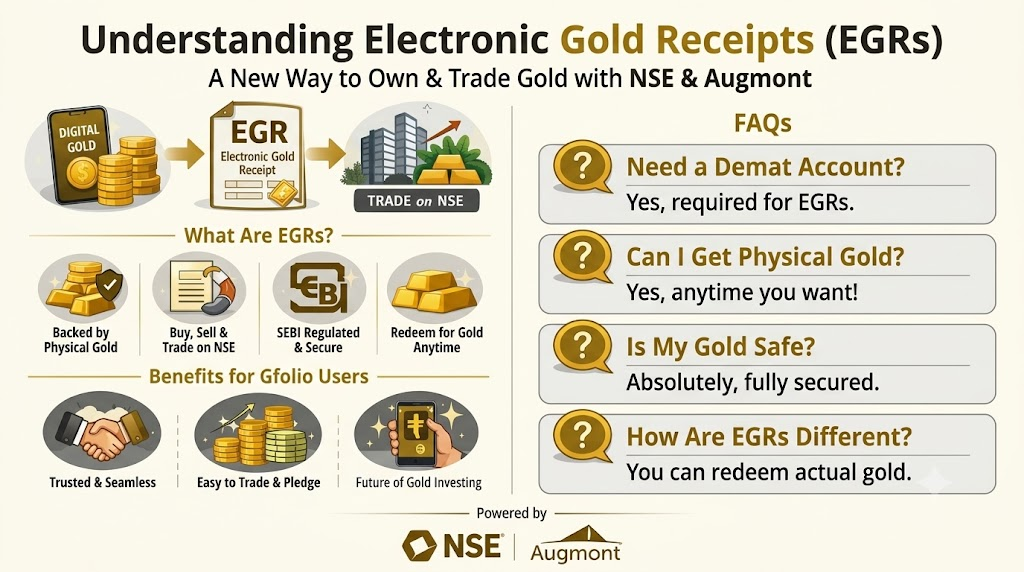
An Electronic Gold Receipt is a SEBI-regulated security that represents ownership of real, physical gold stored in an exchange-accredited vault. Instead of holding a gold coin at home, your gold sits in a secure vault, and your ownership is recorded electronically in your demat account, the same place your shares and mutual funds live.
NSE actually launched the EGR segment earlier this year, on May 4, 2026. The July 15 announcement with Augmont isn’t the launch it’s NSE bringing in one of India’s established bullion and refining players to help the ecosystem scale: creation, redemption, liquidity, physical delivery, and price discovery
Gold-as-a-security on an exchange isn’t entirely new, either. BSE was first, launching India’s original EGR framework in October 2022, after SEBI issued its regulatory blueprint earlier that year. NSE’s 2026 launch extends the same regulated model with deeper liquidity and a second exchange.
How EGRs Actually Work
- An accredited entity deposits physical gold into a SEBI-approved vault.
- The vault manager verifies purity and weight.
- An EGR is created and credited to the investor’s demat account just like a share allotment.
- The EGR trades on the exchange during market hours, at live, transparent prices.
- Whenever the holder wants, they can request redemption and receive actual physical gold.
EGRs come in denominations from 100 milligrams up to 1 kilogram, so both small and large investors can technically participate on paper.
The Part You Should Not Ignore: You Need a Demat Account and a Specific Kind of Broker
This is the detail that decides whether EGRs are actually usable for most people right now:
- You need an active demat account.
- Your broker needs Gold Exchange membership; not every broker has this yet, and as of now several of India’s largest discount brokers still don’t support EGR trading.
- Redemption to physical gold has a narrow window: requests are valid for 3 days, and same-day withdrawal only happens between 10 AM and 3 PM.
- Trading EGRs on the exchange has no GST, but converting them to physical gold attracts 3% GST, the same as buying jewelry.
None of this makes EGRs a bad product. It makes them a product built for investors who already operate in the stock market ecosystem, not for someone who wants to start saving ₹5 a day toward a gold goal without opening a trading and demat account first.
EGR vs Digital Gold Apps vs Gold ETFs vs SGB: Where Does Each Fit?
| EGR | Gold ETF | Digital Gold App (like GFolio) | Physical Gold | |
|---|---|---|---|---|
| Needs Demat Account | Yes | Yes | No | No |
| Minimum Investment | Denomination-based (from 100mg) | 1 Unit | From ₹5 | Full coin/bar cost |
If you already have a demat account and trade regularly, EGRs are a legitimate, transparent, low-cost way to hold gold as a security. If you don’t and most first-time gold savers don’t, a regulated digital gold platform remains the simpler entry point, without account-opening friction.
Why This Matters for India’s Idle Gold Problem

One of the biggest challenges in the Indian economy is the massive amount of gold held in private households, estimated between 30,000 and 35,000 tonnes. The NSE-Augmont partnership is explicitly trying to formalize that pulling gold out of lockers and into a transparent, tradeable, and, in some cases, productive asset (EGR holders can even lend gold to jewelry manufacturers through securities lending and earn interest on it).
That’s a meaningful shift for India’s gold market structurally. But structural shifts at the exchange level don’t automatically translate into accessibility for a 22-year-old saving ₹200 a month or a parent building a small gold fund for a child’s future. That gap between exchange-level innovation and everyday saving habits is where platforms like GFolio continue to matter.
Frequently Asked Questions
1. Is a demat account mandatory for buying EGRs?
Yes. Because EGRs are exchange-traded securities, you need an active demat account and a broker with Gold Exchange membership to buy, hold, or sell them.
2. Can I convert my EGR into physical gold?
Yes. You can request redemption at any time, subject to your broker’s process. Redemption requests are valid for 3 days, and same-day physical withdrawal is only processed between 10 AM and 3 PM.
3. Is GST charged on EGR investments?
No GST applies when you trade EGRs on the exchange. A 3% GST applies only when you convert your EGR into physical gold, the same rate charged on jewellery purchases.
4. How is an EGR different from a Gold ETF?
A Gold ETF gives you units of a fund that holds gold you don’t own physical gold directly. An EGR makes you the direct beneficial owner of a specific quantity of physical gold sitting in a vault, and you can redeem it for the real thing.
5. Do I need EGR to invest in gold, or are there simpler options?
No. EGR is one route among several. If you don’t already have a demat account or don’t want the added step of broker onboarding, regulated digital gold apps let you start investing in gold from as little as ₹5, without opening a separate trading account.
NSE’s partnership with Augmont is a genuine step toward formalizing India’s gold market and putting idle household gold to productive use. It’s a good thing for the ecosystem. But it’s built for investors who are already inside the stock market system, not a replacement for simple, low-barrier gold saving.
If you want gold exposure without opening a demat account, tracking exchange hours, or navigating redemption windows, that’s exactly the gap GFolio is built to fill, backed by Augmont’s certified refinery standards and held in SEBI-regulated insured vaults